
personal story
A Sailboat Named Agape in New York Waters
A recollection of sailing Agape down the Hudson in 1971, encountering the Clearwater, and discovering danger, humor, and grace on the way to New York City.
Published July 1, 2026
The Clearwater — Down the Hudson
One of the many adventures aboard Agape, my 27-foot sailboat with a 9 hp single-cylinder diesel, began after we had finished the Erie Canal. Jack and I were on a summer-long trip from Vermilion, Ohio, to Vero Beach, Florida. By the time we reached Troy, New York, we had covered the canal's 350 miles and passed through some thirty-five locks — every one the canal had to offer.
By then we had learned one hard lesson of canal travel: a sailboat becomes a very different creature when her mast is down. To clear the low bridges across the Erie Canal, we had unstepped the mast and strapped it to the deck. Now, at Troy, with the canal behind us and the Hudson River ahead, we faced the next dilemma. Now we had to get the mast stepped, a week delay in Lorain for some repairs put us seriously over budget.
So we powered on.
Not far down the Hudson, we came upon a sight that stopped us cold: a great wooden gaff-rigged sloop tied up at a small marina. She was 106 feet of graceful, old-fashioned, impossible-to-ignore boat. To anyone who loves boats, she was a sight to behold. We had to stop.
We tied up behind her and quickly learned that she was the Clearwater, the Hudson River sloop made famous by Pete Seeger. She had quite a crew aboard. Some were real sailors, and some were what we might have called hippie landlubbers in those days, but everyone was friendly, accommodating, and full of life. There was a spirit around that boat that was hard to miss.
The Clearwater was not just a boat. She was part of a movement. Pete Seeger and others had built her to draw attention back to the Hudson River and to teach people what pollution was doing to the waters they lived beside but had stopped seeing.
This was 1971, and pollution was not an abstract issue then. It was right in front of us. Rivers and lakes had been treated for years as dumping grounds. Raw sewage went into waterways. Industrial waste was discharged as a matter of routine. Many people had simply accepted it as the cost of progress. I remembered the Cuyahoga River in Ohio, not far from home, catching fire in 1969 — a burning river, a national symbol of how badly we had abused our waters. People joked darkly that the water was so polluted it could be sold as anti-freeze. Whether that story was strictly true or not, it captured the feeling of the time. We had reached a point where a burning river no longer seemed impossible.
We met several people aboard the Clearwater. One of them was a Native American protest singer named Roland Mousaa. Another was a young neurosurgeon from New York City. Roland and the surgeon asked if they could ride with us to New York City, about 140 miles down the Hudson. At the time I did not know that Roland and Pete Seeger were friends. Pete was not aboard the Clearwater then, but his presence seemed to be everywhere around that boat — in the music, in the cause, and in the odd assortment of people drawn to it.
Only decades later did I learn who our passenger really was. Roland Mousaa had helped Pete Seeger start the Clearwater organization itself, and Pete would come to describe him as one of the great unknown musicians anywhere. And there was something else I could not have known: Roland had refused to fight in Vietnam. Two objectors to the same war, sharing the deck of a boat named Agape — and neither of us knew it.
I cannot remember the surgeon's name now, but I remember his energy. He was anxious to get downriver, and he was also a sailor, which gave us some comfort. It gave us an experienced hand to help us navigate these unfamiliar waters.
Before we left, the captain of the Clearwater offered to step our mast with his halyard rig. It was an effortless act of generosity that solved our biggest problem in a matter of minutes. At twenty years old, you just chalk that kind of luck up to the universe, pocket the favor, and keep moving. Looking back now, half a century later, I see it differently. I can see the Almighty's hand in it, working through an odd assortment of Hudson River hippies to make the world, and our little journey, whole again, even if I was too blind to recognize it at the time.
The next day we left for New York City.
The Hudson was no small river to us. It carried freighters, yachts, workboats, barges, and pleasure craft, all sharing the same water. At times everything seemed to be aiming for the same narrow opening beneath the same bridge. The young surgeon wanted to travel through the night, and on the first night we tried it.
Sometime in the middle of the night we had good wind and were under sail. I was at the helm. Jack and Roland were asleep. The surgeon was awake, studying the charts and watching for obstacles, rocks, shallow water, channel markers, anything that could ruin us in the dark.
Ahead of us, the channel narrowed near an upcoming bridge. We were preparing to jibe for a better angle through the passage when we looked behind and saw an enormous freighter bearing down on us.
We assumed he had not seen us. There was no signal. No warning. Just that dark mass coming on.
We had seconds to decide. If we stayed our course and waited for him to pass, there would be insufficient water. If we tried to pull up and drift, we feared the bow wake or suction from that monster vessel might draw us into him. The only choice that made sense in the moment was to jibe, cross his bow, and try to clear him on the other side.
A 27-foot sailboat, even with a good wind, is not a fast boat. Full speed for Agape was maybe five or six knots on a fine day. Crossing in front of that freighter felt like walking across railroad tracks with a fast-moving train coming.
But we made it.
Barely.
Even then we were not sure we were safe. His wake could still throw us around. His size could steal the wind from our sails. Everything about him seemed too large for our little boat and too close for comfort.
Looking back, it was one of those moments when experience, instinct, luck, and timing all seemed to come together. At the time, though, it mostly felt terrifying.
You would think a sailboat named Agape would have inspired a little more confidence in its crew. But we were young, tired, frightened, and probably too full of ourselves to appreciate how fortunate we had been.
By that point, I was done with sailing through the night. We found a marina and tied up.
Once we were tied up and secured, we crawled into our bunks and slept.
But I managed to give our guests one more bit of drama.
By then my late-night "we are drifting" nightmares had become old news to Jack and me. I still had them occasionally. Somewhere before sunrise that morning, I woke up screaming, "We're adrift!" Then, having done my duty as ship's alarm, I promptly fell back asleep.
The young neurosurgeon, however, did not know this routine.
He jumped out of his bunk naked and went running around the boat, checking lines in a well-lit marina where we were quite safely tied. I explained it to him the next day, but by then I think he had already decided he was ready to be home. He was not pleased. I never did ask him why he slept naked.
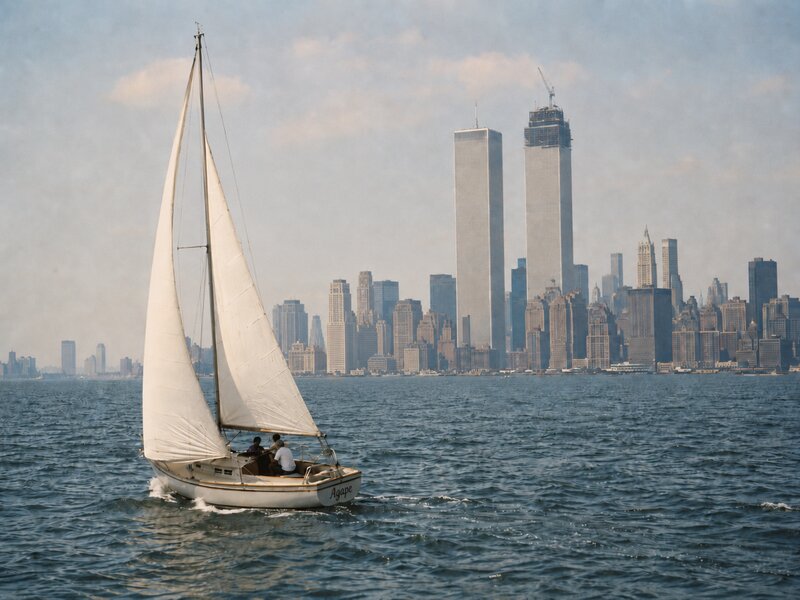
We came down the last stretch of the Hudson toward a skyline in the middle of remaking itself. Over lower Manhattan stood the World Trade Center — one tower finished, its twin still climbing, bare steel and cranes against the sky. We sailed past it the way you pass anything enormous and half-born, with no idea what its story would be.
We arrived in New York City still mostly oblivious to what was coming next.
The surgeon guided us to a place where we could tie up. To the Ohio-born sailors, it looked rather ominous. The kind of place where you looked twice at every shadow and wondered whether your boat would still be there when you came back. The surgeon assured us it would be fine. Then he invited us to his apartment for the night.
Jack was excited. I was less excited, especially when the surgeon mentioned some "dope" he had acquired.
We left Agape and walked through broken-out, empty warehouses toward the nearest subway. Jack and I kept looking at each other in bewilderment. It was our first time on a subway, and here we were walking through a dilapidated part of New York City at night. I could not get my mind off the boat.
Would she be there when we returned?
After a while, we reached his apartment. We tried the hash, and I became thoroughly paranoid. Imagine that: hash, paranoia, my first night in New York City, and my sailboat tied up somewhere behind us in the dark.
I insisted we leave.
So we found the subway again, though we had no real idea where we were going. We only knew the boat was south of where we were. We rode for what we guessed was about the same amount of time, got off, and stepped back into the city.
How hard could it be? We only had to ask someone where the river was.
In New York City.
At night.
The first person we saw, Jack stopped and asked for directions. The person took one look at Jack, unshaven, hair uncut for years, looking like he had just stepped out of a long and questionable voyage, and ran the other way.
Maybe this was not going to be as easy as we thought.
I tried the next person, asking as politely as a hash-stoned vagrant could manage. He did not say much. He just pointed and left without stopping.
So we started walking in the direction we hoped was toward the river. Our plan, if it could be called a plan, was to find the waterfront and then walk up and down until we found the boat. In our minds, this seemed reasonable.
Eventually we came upon a set of warehouse buildings that looked similar to the ones we had passed earlier. But this time the warehouse was not empty. It was full of homeless men, poor souls trying to sleep wherever they could find shelter. There we were, two suspicious-looking vagrants ourselves, tiptoeing around the edges of what felt like a wall-less hotel for the homeless, trying not to wake anyone and trying even harder not to look as lost as we were.
Looking back, I suppose it was a kind of blessing that Jack and I looked ragged enough ourselves that no one paid much attention to us. We were not tourists by appearance. We were two young, worn-out sailors who had wandered into the underside of the city and were trying to find our way back to a 27-foot boat named Agape.
And at last, there she was.
Home sweet home.
More of the Story, Agape Anchor Away
---
More of the Story, Agape Anchor Away