
personal story
Anchor Away
A young sailor recalls losing an anchor off Atlantic City and learning, over time, that what holds a life must be secured before the test comes.
Published July 1, 2026
Anchored — Part I
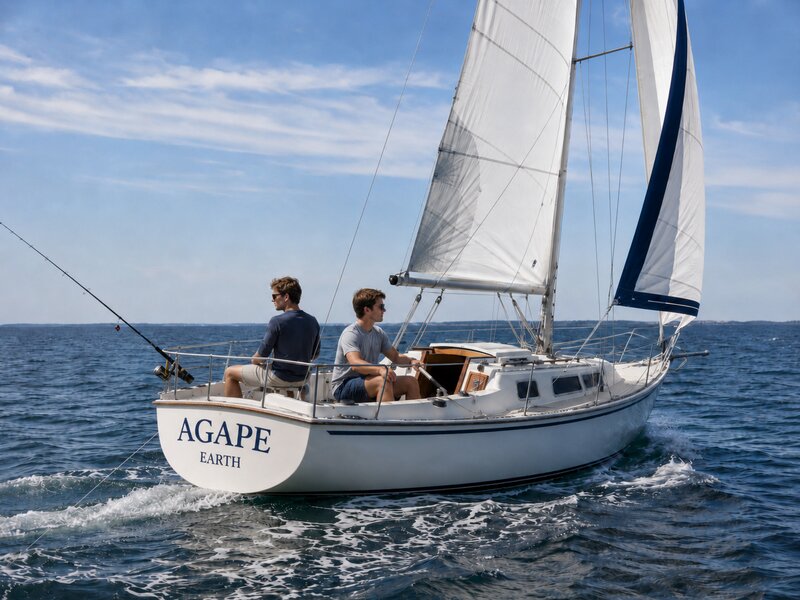
In the summer of 1971, a 27-foot sloop named Agape was commissioned for a purpose that sounded simple enough at the time: teach two nineteen-year-old boys how to sail, then carry them from Vermilion, Ohio, all the way to Florida.
We were young enough to think distance was mostly a matter of courage, and inexperienced enough to believe a boat would teach us only what we needed to know after we had already left shore.
I remember one casual part of the journey when my friend Jack, who could sometimes be a little too impulsive, suggested we anchor and scuba dive for a while. We happened to be off the coast of Atlantic City. I had been told that in summer, sharks tended to live close to the coast and breed there with great enthusiasm, but I did not know that then. The movie that would make such waters famous was still a decade in the future.
Jack tossed the anchor overboard. I heard the chain rush over the bow roller, link after link, and then the sudden silence that meant something had gone very wrong.
"Ahhh, shit."
I knew immediately.
There was one rule we were supposed to check every time: make sure the rope was tied to the end of the chain. Most people would have kept a rope permanently attached, but we were young, inexperienced, and too broke to do everything the proper way.
"Jack," I said, already knowing the answer, "you did tie the rope to the chain, didn't you?"
What followed was a brief exchange in perfect sailor talk, which is to say it was not very perfect and not very polite. For a moment we nearly came to blows, until the real question settled over both of us.
"Who's going over to look?"
Jack volunteered, but I was not having it. By then I had no patience left, and I was not sure what else he might manage to lose. Besides, the responsibility felt partly mine too. We both knew the rule. We both had failed to check it.
"No," I said. "I'll go."
The odds of finding that anchor on the bottom felt somewhere between slim and none.
So, in another stroke of genius, I said, "Jack, I'll hang off the transom. You pull me in small circles, and I'll dive down and check."
Jack proceeded to troll with me like bait hanging off the back of the boat.
We had some experience diving, mostly in the Keys, and we had often seen fish that deserved a little respect. But this was not like that. The water was darker than I expected, deeper than I wanted, and then I noticed a few anxious fins moving through the same area.
They were not dolphins.
"Jack!" I yelled. "Look at these!"
"What?" he called back.
"Get me the hell out of here!"
Naturally, Jack decided the best response was to troll a little faster.
By then the diesel was drowning out anything that might have passed for a desperate scream, so I made the only decision that seemed reasonable at the time.
I let go.
I knew Jack would have to come back for me. I also figured I might look less appetizing if I stopped flailing around like wounded bait.
When I finally climbed back onto the boat, beaten and breathing hard, we looked out over the water.
Jack pointed and said, "Hey, look. There's some shark out there."
"Yeah," I said. "I know."
I also knew we could not make it to Florida without an anchor. A sailboat may move by wind, but it survives by knowing when and how to stop. So we turned toward the nearest port to figure out how two broke nineteen-year-olds were going to replace the one thing we could not afford to lose.
I did not know it yet, but Agape was already doing what she had been built to do. She was not merely carrying us south. She was teaching me something I would spend a lifetime learning: an anchor is only useful if it is attached.
The rest of that lesson was waiting for us at the marina.
Continued in Part II. What Are We Anchored To?