
The Small Courage of a Monarch Butterfly
A quiet reflection on fragility, transformation, and the small signs of mercy God places before us.
Published June 12, 2026
The Small Courage of a Monarch Butterfly
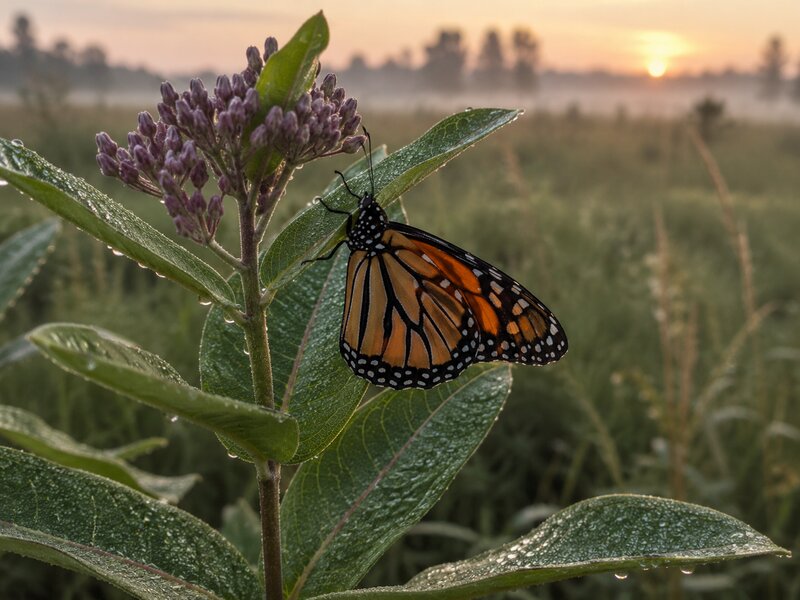
I saw a monarch butterfly moving through the air as if it had no right to survive and yet fully intended to.
Its wings were thin, almost weightless, orange marked with black like stained glass held up to the sun. It did not hurry in the way I hurry. It did not seem anxious. It rose, dipped, paused, and continued. A small creature, easily bruised by wind or rain or careless hands, crossing a world much larger than itself.
I stood still longer than I meant to.
There are moments when God allows one small thing to interrupt our noise. Not with thunder. Not with an answer to every question. Just with a living sign that says: look again.
A Fragile Teacher
A monarch butterfly is not impressive by the standards we often use. It has no strength that can be measured in the usual way. It cannot command a room. It cannot defend itself with force. It cannot explain its beauty.
And yet it bears witness.
It begins as something low to the ground, hidden in the ordinary green of milkweed. It passes through hunger, stillness, enclosure, and change. Then, by a mystery woven into creation, it emerges with wings.
I do not want to make nature into a sermon too quickly. A butterfly is a butterfly, not a Bible verse with wings. Still, creation has a way of humbling us. It teaches without pretending to be the whole lesson.
The monarch reminded me that transformation is often quiet before it is visible.
Much of the work of God in a person is not immediately beautiful. Sometimes it feels like being stripped down. Sometimes it feels like waiting in a dark place with no evidence that anything holy is happening. Sometimes it feels like weakness, not progress.
But weakness is not the same as absence.
Not every season of stillness is a sign that nothing is happening. Some forms of life are being made where no one can see.
The Journey We Did Not Choose
Monarchs are known for migration. Some travel astonishing distances, generation after generation, following a path they did not invent. They are born into a journey larger than their own lifespan.
That part stays with me.
Most of us are also born into journeys we did not choose. We inherit family stories, wounds, hopes, responsibilities, and questions. We carry names, griefs, and prayers that began before us. We live inside histories larger than our understanding.
There is comfort in remembering that we are not the first to travel.
The life of faith is not a private invention. We walk a road already marked by the mercy of God and by the footsteps of those who trusted Him before us. Some walked with clear vision. Some walked with trembling. Some limped. Some sang. Some could only whisper.
But they walked.
And perhaps that is enough for today: not to understand the whole map, but to receive the grace to continue.
Beauty Without Boasting
What struck me most about the monarch was not only its delicacy, but its unselfconscious beauty.
It did not perform. It did not ask to be admired. It did not compare itself to the birds, the bees, the trees, or the people passing by. It simply lived the life given to it.
There is a holiness in that simplicity.
So much of our weariness comes from trying to become visible in the wrong way. We want to matter, but we often confuse mattering with being noticed. We want to be fruitful, but we confuse fruitfulness with constant motion. We want to be loved, but we confuse love with approval.
The monarch has no such burden.
It receives its pattern. It opens its wings. It moves through the light.
This does not mean human life is simple. We bear sorrows butterflies do not bear. We carry moral responsibility. We must repent, forgive, choose, endure, and love when love is costly. But perhaps we still need the reminder: we are creatures before we are achievers.
We are received before we produce.
We are held before we understand.
A Gentle Rebuke to Despair
There are days when the world feels too heavy for hope. The news is full of violence. Families fracture. Bodies fail. Churches disappoint. Private griefs continue long after others assume we should be better.
On such days, a butterfly can feel almost offensive in its beauty.
How dare something so small be radiant in a world like this?
But maybe that is part of its witness. Beauty does not deny sorrow. It refuses to let sorrow have the final word.
The Christian hope is not optimism dressed in religious language. It does not pretend that death is harmless or that suffering is easily explained. Scripture speaks of creation groaning, of tears, of waiting, of longing for redemption. References like Romans 8 and Revelation 21 are not sentimental escapes; they are anchors for people who know the weight of the world.
The monarch’s fragile flight did not answer all my questions. It did not erase grief. It did not make hard things easy.
But it did rebuke my despair gently.
It reminded me that the God who made the great lights also made delicate wings. The God who governs history also attends to hidden transformations. The God who calls us to endurance also gives signs of tenderness along the road.
Learning to Notice Again
I think many of us are starved for noticing.
We scroll past wonders. We rush past neighbors. We eat without tasting, speak without listening, pray without pausing. We are overfed with information and undernourished in attention.
A monarch butterfly cannot heal all of that. But it can invite us to stop.
To look.
To remember that the world is not merely a machine of tasks and threats. It is creation. It is wounded, yes, but still bearing traces of the One who called it good.
The Prayer of Open Wings
After a while, the monarch moved on. It crossed the yard in uneven grace and disappeared beyond what I could see.
I went back to my day, but not exactly the same.
That is often how grace works. It does not always rearrange the whole landscape. Sometimes it changes the way we stand inside it.
I thought of how often I ask God for strength, and rightly so. But perhaps I also need to ask for the courage to be small without shame. To receive transformation without demanding control. To move when it is time to move, and to be still when it is time to be hidden.
A monarch butterfly does not survive by becoming less fragile. It lives according to the life entrusted to it.
May we do the same.
May we learn to trust the Maker in the hidden places.
May we not despise small beginnings.
May we keep walking the path of mercy, even when we only see the next few feet.
And when grace lifts us, however gently, may we open our wings.