
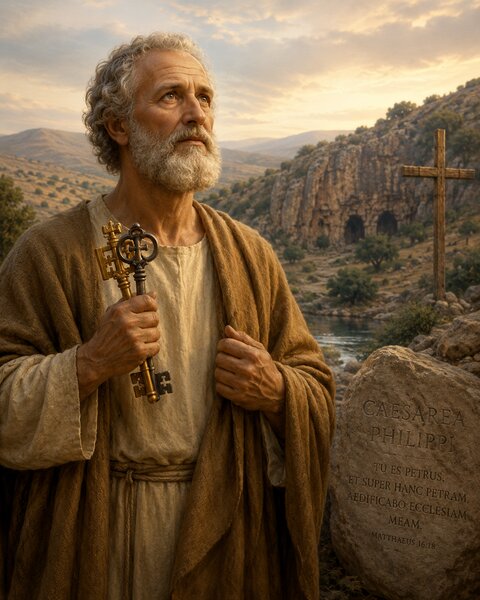
Peter, the Rock, and the Cross
A reflection on Peter’s confession at Caesarea Philippi, the Catholic understanding of his mission, and the way the Cross purifies authority, faith, and discipleship.
Published July 1, 2026
At Caesarea Philippi, far from Jerusalem and surrounded by monuments to worldly power and pagan worship, Jesus asks the question that every disciple must eventually answer: “Who do people say that the Son of Man is?”
The answers are respectful. Some say John the Baptist, others Elijah, others Jeremiah or one of the prophets. The crowds know Jesus is not ordinary. They recognize in Him the force of heaven, the voice of God, the authority of a prophet. But admiration is not yet faith. To call Jesus a prophet is to honor Him, but it is not enough. He is not merely one who speaks for God. He is God speaking.
So Jesus presses further: “But who do you say that I am?”
Simon Peter answers for the Twelve: “You are the Christ, the Son of the living God.”
This confession stands at the heart of the Gospel and at the heart of the Catholic understanding of the Church. Peter does not arrive at this truth by political calculation, personal brilliance, or spiritual enthusiasm alone. Jesus says plainly: “Blessed are you, Simon Bar-Jonah! For flesh and blood has not revealed this to you, but my Father who is in heaven.”
Peter’s faith is a gift before it is a responsibility. He receives before he governs. He confesses before he is commissioned.
Then Jesus gives Simon a new name and a new mission: “And I tell you, you are Peter, and on this rock I will build my Church, and the gates of Hades shall not prevail against it.”
For Catholics, these words are not a decorative compliment. They are foundational. Jesus renames Simon as Peter, “rock,” and links that name to the building of His Church. Just as Abram becomes Abraham and Jacob becomes Israel when God gives them a covenantal mission, Simon becomes Peter when Christ entrusts him with a role in the new covenant community.
The rock is not Peter apart from Christ, as though the Church rests on the strength of one man. Christ alone is the Lord, the cornerstone, the Savior, the true foundation without whom nothing stands. But Christ, in His freedom, chooses to build visibly and historically through human instruments. Peter is rock because Christ makes him rock. His authority is derivative, not independent; received, not seized.
Jesus continues: “I will give you the keys of the kingdom of heaven, and whatever you bind on earth shall be bound in heaven, and whatever you loose on earth shall be loosed in heaven.”
The image of keys evokes authority in the household of the king. In Isaiah 22, the steward of the house of David receives “the key of the house of David,” with authority to open and shut. In Matthew 16, Jesus, the Son of David and King of the kingdom, entrusts keys to Peter. Catholic tradition sees here the biblical root of Peter’s primacy: not a domination over the Church, but a ministry of stewardship, unity, and authoritative service within the Church.
This is why Catholics understand the pope, the bishop of Rome and successor of Peter, as holding a unique office in the communion of bishops. The papacy is not the invention of ecclesiastical ambition, but the continuation of a Petrine ministry given for the sake of the Church’s unity in faith. The pope does not replace Christ. He does not stand above the Word of God. He is not a new revelation. His task is to strengthen the brethren, guard the apostolic faith, and serve the unity of the flock.
Yet the Gospel immediately prevents any triumphalist misunderstanding.
After Peter’s confession and commission, Jesus begins to show His disciples that He must go to Jerusalem, suffer many things, be killed, and on the third day be raised. The Messiah is not going to conquer by avoiding suffering. He will reign from the Cross.
Peter, the newly named rock, takes Jesus aside and rebukes Him: “God forbid, Lord! This shall never happen to you.”
Then comes one of the sharpest corrections in all of Scripture: “Get behind me, Satan! You are a hindrance to me; for you are not on the side of God, but of men.”
The contrast is stunning. In one moment Peter speaks by revelation from the Father. In the next, he becomes an obstacle to the mission of the Son. He is blessed, then rebuked. He is rock, then stumbling block.
This tension is essential to the Catholic interpretation. Peter’s authority does not mean Peter is personally flawless. His office does not erase his need for conversion. Grace does not make him immune from fear, confusion, or temptation. The same Peter who confesses Christ will misunderstand the Cross. The same Peter who receives the keys will deny Jesus three times. The same Peter who is restored by the risen Lord will later need correction from Paul in Antioch.
Catholic teaching has never claimed that Peter, or his successors, are sinless men. The doctrine of papal infallibility, often misunderstood, does not mean that every papal statement, decision, policy, prudential judgment, or personal opinion is free from error. It means that under specific conditions, when the pope definitively teaches a doctrine of faith or morals to be held by the whole Church, Christ preserves His Church from being bound to error. The gift belongs to the Church before it belongs to the man. It is a protection of the flock, not a celebration of the shepherd’s personal superiority.
Matthew 16 therefore holds together what must never be separated: authority and conversion, confession and cross, office and discipleship.
Peter is not rebuked because he lacks affection for Jesus. He is rebuked because his love has not yet been purified by the Cross. He wants a Messiah without suffering, glory without sacrifice, victory without self-giving. In that moment, Peter thinks as men think. He sees suffering as failure. Jesus reveals that, in the mystery of divine love, the Cross will be the throne.
“Get behind me, Satan” is not a rejection of Peter’s calling. It is a command to return to the proper place of a disciple. Peter has stepped in front of Jesus, trying to redirect the path of the Lord. Jesus tells him to get behind Him, to follow rather than lead according to human fear. The rock must learn to be a disciple before he can strengthen his brothers.
This is also a word for the whole Church. Whenever Christians confess Jesus as Christ but refuse the way of the Cross, we repeat Peter’s mistake. Whenever we want the kingdom without repentance, mercy without sacrifice, truth without obedience, or unity without humility, we begin to think not as God does but as men do.
The Church built on Peter is not built on worldly power. It is built on faith in the crucified and risen Christ. Its authority is real, but it is cruciform. Its unity is visible, but it is sustained by grace. Its mission is public, but its heart is the confession that Jesus is “the Christ, the Son of the living God.”
Peter’s confession remains the question placed before every generation: Who do you say Jesus is?
Not who do scholars say He is. Not who do crowds say He is. Not who does culture permit Him to be. Who do you say He is?
If He is only a teacher, we may admire Him and move on. If He is only a prophet, we may quote Him selectively. If He is only a symbol, we may shape Him into our own image. But if He is the Christ, the Son of the living God, then He is Lord. And if He is Lord, then we do not correct His Cross. We follow Him through it.
The beauty of Peter is that he shows us both the dignity of faith and the poverty of the believer. He is capable of receiving revelation and capable of resisting redemption. He can speak the truth of heaven and still need to be humbled. He can be chosen by Christ and still need mercy.
That is why Peter is such a fitting sign for the Church. The Church is holy because Christ is holy, yet she is made up of sinners being saved. She carries divine truth in earthen vessels. She is entrusted with keys, yet she must always kneel at the foot of the Cross. She proclaims with authority, yet she lives by mercy.
At Caesarea Philippi, Jesus does not merely ask for an opinion. He draws forth a confession, establishes a Church, gives authority, and reveals the cost of discipleship. Peter’s rock-like mission and Peter’s rebuke belong to the same Gospel scene because the Church must always remember both: Christ truly gives authority, and Christ alone remains Lord.
The rock stands only because it is held by the cornerstone. The keys open only because they belong to the King. The confession saves only because the Father reveals the Son. And Peter, like all of us, must learn again and again to get behind Jesus and follow Him on the way of the Cross.