
The One Bread and the Burning Heart
A reflection on John 6, Emmaus, and the Eucharist as Christ’s self-giving presence that opens our eyes, forms communion, and sends us in love.
Published June 13, 2026
There is a moment in John 6 when the crowd’s hunger changes shape.
At first, they are hungry in the most ordinary and honest way. They have followed Jesus across the Sea of Galilee, they have listened, they have stayed longer than their provisions allowed, and now evening is coming. Jesus sees them before they ask. He takes the loaves, gives thanks, and feeds them until everyone is satisfied. Nothing is wasted. The fragments are gathered. The sign is abundant, tender, practical.
But the next day, when the crowd comes looking for him again, Jesus refuses to let the miracle remain only a miracle of bread. He presses deeper. He tells them not to work for the food that perishes, but for the food that endures for eternal life (). They want another sign, another provision, another proof. They speak of manna in the wilderness, the bread God gave their ancestors. Jesus answers with words that are both gift and stumbling block: he identifies himself as the bread of life ().
John 6 deepens our sense of Jesus because it will not allow us to reduce him to a teacher who gives us ideas, a prophet who gives us moral clarity, or even a miracle worker who gives us help in crisis. He gives all of that, but he gives more. He gives himself.
This is the heart of the scandal and the mercy. Jesus does not merely point toward life from a safe distance. He is the life. He does not simply explain the Father’s generosity; he embodies it. He does not only provide bread; he becomes bread for the life of the world. In John 6, he speaks of the bread he will give as his flesh, given for the life of the world (). His teaching is not separable from his self-offering. His words are not abstract principles floating above the wounds of the world. They are spoken by the one whose body will be broken and whose blood will be poured out.
That is why John 6 can feel both consoling and demanding. It comforts us because it tells us that God’s answer to human hunger is not distant instruction but communion. God does not look upon our weakness and send merely a message. In Christ, God comes near enough to be received. Yet it also demands something of us because to receive Jesus as the bread of life is to stop treating him as an accessory to our projects. Bread is not admired from afar. Bread is taken in. Bread becomes part of us. The life of Christ is meant to become our life.
This is also why the Emmaus story is so luminous.
Two disciples walk away from Jerusalem with grief in their bodies. They had hoped Jesus was the one to redeem Israel, but hope now feels buried. They have heard rumors of an empty tomb, but they do not yet know how to live in the light of it. The risen Christ comes near, but they do not recognize him. He asks them what they are discussing. He lets them tell the story as they understand it, with all its sorrow, confusion, and disappointment.
Then he opens the Scriptures.
Beginning with Moses and all the prophets, he interprets the things about himself. He shows them that the suffering of the Messiah was not the defeat of God’s plan but the strange path of its fulfillment. Their hearts burn as he speaks. The Word begins to gather the scattered pieces of their hope. Scripture becomes not a closed book of past events but a living testimony to Christ crucified and risen.
Still, their eyes are not opened until the table.
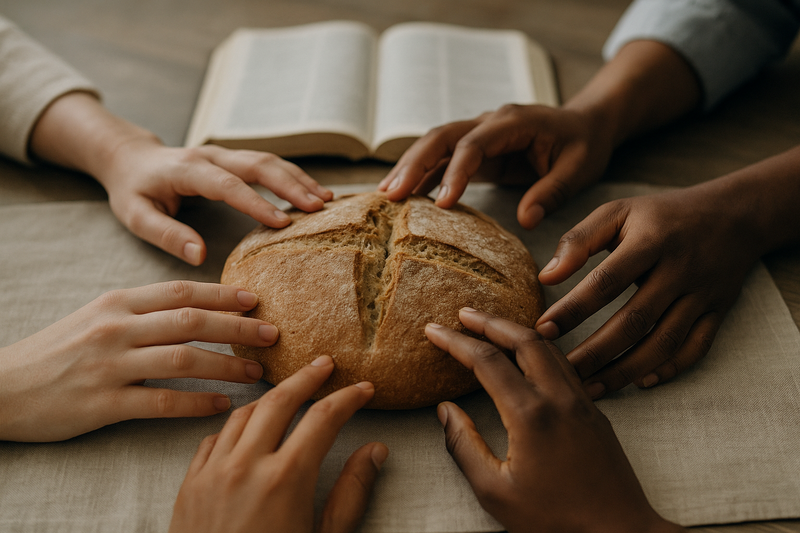
They urge the stranger to stay with them, because evening is near. He goes in. At the meal, he takes bread, blesses it, breaks it, and gives it to them. Then their eyes are opened, and they recognize him. The pattern is unmistakable. On the road, Christ opens the Scriptures; at the table, he is known in the breaking of the bread.
Emmaus shows that Scripture and Eucharist belong together because both are, in distinct ways, modes of Christ’s self-giving. In Scripture, Christ speaks and interprets our lives through the story of God’s faithful love. In the Eucharist, Christ gives himself truly as the bread of communion. The Word prepares the heart to recognize the gift; the breaking of bread reveals the presence of the one to whom the Word bears witness.
When these are separated, both are diminished in our imagination. Scripture without communion can become information without intimacy, a text we master rather than a voice that masters and heals us. Eucharist without attentiveness to Scripture can be received with a diminished memory of the great story of creation, covenant, exile, promise, cross, and resurrection. But together, as in the Church’s liturgy, they form us as disciples on the way. The Scriptures set our hearts aflame; the bread opens our eyes. The Word announces the Christ who gives himself; the Eucharist draws us into that gift.
Paul speaks of this mystery with striking directness. Writing to the Corinthians, he asks whether the cup of blessing is a participation in the blood of Christ and whether the bread that is broken is a participation in the body of Christ ().
Participation means more than mental recollection. It is not less than remembrance, but it is more than remembering from a distance. To participate is to share in, to be drawn into, to have communion with. Paul is saying that in the blessed cup and the broken bread, the church is given a real sharing in the life of the crucified and risen Lord.
This does not mean we possess Christ or control him. It means he graciously gives himself to us. The cup is communion in his blood, the life poured out for the forgiveness and reconciliation of the world. The bread is communion in his body, given for us and for many. In receiving, we are not spectators of grace. We are made participants in it.
And Paul immediately connects this participation with the shape of the community. Because there is one bread, the many are made one body by partaking of that one bread (). The Eucharist is not only about “Jesus and me,” if that phrase is used to avoid “Jesus and us.” Communion with Christ creates communion among those who receive him. The one bread gathers the many into one body.
This is where the Eucharistic table becomes both mercy and examination.
It is mercy because Christ receives us before we know how to receive one another. He calls sinners, doubters, the wounded, the weary, and the poor in spirit to repentance, healing, and communion. He gives himself not as a reward for the already whole but as medicine for the sick. He meets us in our hunger and does not despise our need.
But it is judgment because the one bread exposes every form of selfishness that contradicts it. We cannot truthfully receive the body of Christ while despising the members of Christ’s body. We cannot come to the same table and then live as though our neighbor’s suffering is none of our concern. We cannot bless the cup of the self-giving Lord and remain comfortably committed to our own self-protection, superiority, or indifference.
The Corinthians had to hear this sharply. Their gatherings reflected the divisions of their society. Some ate well while others went hungry. The Lord’s Supper had become entangled with status, impatience, and humiliation. Paul tells them that this is not a small social flaw; it is a failure to discern the body. To receive the bread while ignoring the wounded body of the community is to misunderstand the sacrament itself.
The same challenge remains. The one bread asks hard questions of every congregation and every heart. Who has been pushed away from Christ by our coldness, contempt, or failure to welcome them toward the fullness of communion? Who is present but unseen? Whose hunger do we spiritualize because meeting it would cost us something? Where have we allowed politics, class, race, resentment, or pride to speak more loudly than the body and blood of the Lord?
Receiving one bread challenges selfishness because it schools us in gift. We do not seize the Eucharist; we receive it. We come as beggars before a gift. This posture is meant to follow us out of worship and into daily life. If everything most essential is received, then our lives cannot be built on grasping. The bread of life frees us from the anxious myth that we must secure ourselves at the expense of others.
Receiving one bread challenges division because it makes visible a unity we did not create. The church is not one because its members are naturally compatible, culturally identical, or temperamentally alike. The church is one because Christ is one, and he gives one bread. Eucharistic unity is not sentimental. It does not erase real wounds or excuse injustice. Rather, it calls us into the hard and holy work of reconciliation, truth-telling, repentance, forgiveness, and repair. We are not allowed to make peace with contempt.
Receiving one bread challenges indifference because communion with Christ draws us into his compassion. The body given for the life of the world teaches us to notice bodies: hungry bodies, imprisoned bodies, displaced bodies, exhausted bodies, disabled bodies, grieving bodies, bodies treated as disposable. The Eucharist trains our eyes to see that love of God cannot be severed from love of neighbor. The Christ who gives himself as bread also identifies himself with the hungry who are fed ().
The Scriptures set our hearts aflame; the bread opens our eyes.
So the story that begins with bread in the wilderness continues on the road to Emmaus, at the table in Corinth, and in every community that gathers in Christ’s name. We come hungry, often more hungry than we know. We bring our confusion, our fractured hopes, our partial understanding, and our divided hearts. Christ comes near. He opens the Scriptures. He breaks the bread. He gives himself.
And then, like the disciples at Emmaus, we are sent back toward the place of witness. They rose that same hour and returned to Jerusalem. The recognition of Christ did not lead them into private spiritual satisfaction but into renewed communion with the others. The table became mission. The broken bread became courage. The burning heart became testimony.
This is the grace and the summons of the Eucharistic life: to receive the one who gives himself, and to become, by his mercy, a people given for the life of the world.