
personal story
So I Wanted You
A college student discovers a piece of her mother’s past and begins to hear an old argument about freedom differently. *Part 1 of a two part article.
Published July 18, 2026
Whatever I Want
The argument happens at Pop's kitchen table, over the news, the way arguments in that house always do.
Emma is twenty-one and home for fall break, and she is good at this now. Three years of seminars have sharpened her. When the story comes on and Pop makes the sound he makes, half sigh, half word, she is already loading.
"It's my body," she says. "I can do whatever I want with it."
She waits for him to come back at her the way he comes back about taxes and the Bible. She has her second and third points ready.
But Pop just stirs his coffee. He stirs it longer than coffee needs.
"You're right," he says. "You can."
That's all. He asks if she wants more pie.
She wins the argument. On the drive back to campus she keeps winning it, out loud, alone in the car, adding all the points he never made her use. It's four hours to school. Somewhere around hour three she notices she's still arguing with a man who agreed with her, and she turns the radio up.
---
In March her mother sells the house.
It's a good thing, smaller place, less yard, closer to work, but it means the attic, and the attic means Emma, because her stepdad's knee is done and her mother cannot be trusted to throw anything away. So Emma spends a Saturday in the rafters handing down boxes of her own childhood: the science fair ribbons, the recital programs, a clay handprint with her name scratched in it backwards.
The shoebox is under the Christmas stuff. It isn't labeled. Inside there's a hospital bracelet, impossibly small, September 2004. A pacifier still in its packaging. A spiral notebook with a bent cover.
And an appointment card. Heavy paper gone soft at the corners. A clinic on Raymore Street, a Tuesday in March, 8:30 a.m.
March 2004.
Emma does the math twice, sitting cross-legged under the attic light, because the first time she doesn't want it to come out the way it comes out.
She knows the story of her own life the way you know a house you grew up in, without ever having looked at it. Mom had her young. Mom finished nursing school late. The guy, Emma has never called him anything else, left before she was born. Her stepdad came along when she was six and that was that. These were just facts, furniture, things that had always been where they were.
She opens the notebook. Most of it is nothing, class notes, a grocery list, a phone number with no name. But near the back there's an entry with a date, the Monday before the Tuesday, and her mother's handwriting, younger and rounder than it is now:
Everyone keeps saying the same sentence to me. It's your body, you can do whatever you want. Sarah said it. Mom said it. He said it before he left, like a gift he was giving me. They're all right. That's the thing. They're right and it doesn't help. Nobody will tell me what I should want. They just keep handing me the choice like it's an answer.
There is no entry for the Tuesday. There is nothing else until June, a single line:
Felt her move today. Like a fish. Like a secret.
---
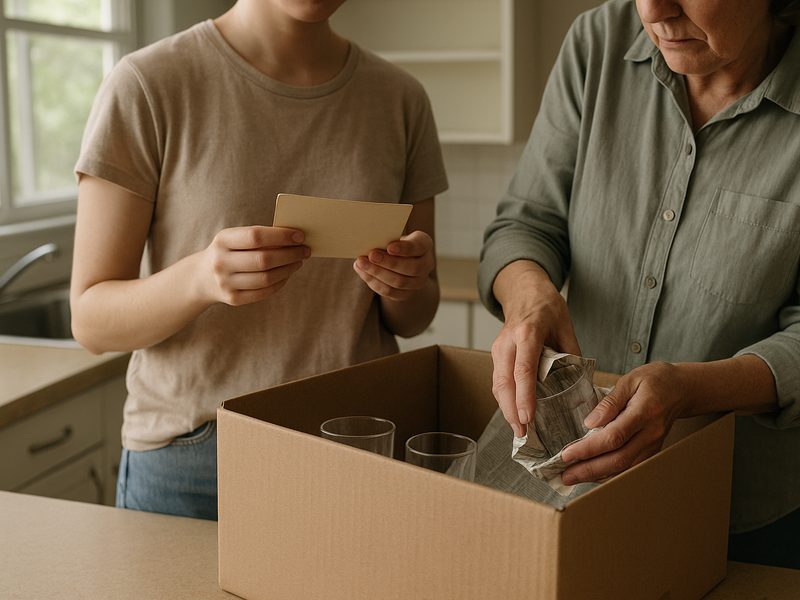
Emma comes down from the attic and finds her mother wrapping glasses in newspaper.
She doesn't plan what she says. She just holds out the appointment card, and her mother looks at it for a long moment, and then keeps wrapping the glass in her hands, carefully, all the way, before she sets it in the box.
"You went through the shoebox."
"You made an appointment."
"I did."
"You never told me."
"No."
"Why not?"
Her mother sits down on a kitchen chair that is already sold, in a house that is already sold, and looks at her daughter for a while.
"Because I didn't want you to feel like a debt," she says. "You weren't a debt. You were never a bill I paid. If I'd told you, you'd have spent your whole life trying to be worth it, and that's not" She stops. Starts again. "That's not what you were for."
Emma stands there holding the card. Twenty minutes ago it was heavy paper. Now it weighs what it weighs.
"Everyone said it was your choice," Emma says.
"It was." Her mother smiles, and it isn't bitter, which is somehow the hardest part. "It was my body. I could do whatever I wanted."
She reaches out and tucks a piece of hair behind Emma's ear, the way she has done ten thousand times, with the hand that filled out the card and then didn't drive to Raymore Street.
"So I wanted you."
---
Emma drives back to school on Sunday. She doesn't cry until Ohio, and then not for long, and she couldn't say exactly what the crying is about. Not guilt. Something underneath where guilt would go. She keeps looking at her own hands on the wheel, the actual hands, the ones that were built cell by cell inside a twenty-year-old who was terrified, who was handed her freedom from every direction like it was an answer, and who found out it was only ever a question.
You can do whatever you want.
True. Her mother proved it was true.
It just never says what's worth wanting. It hands you the pen and walks out of the room.
Two weeks later the group chat blows up about the same story on the same news, and someone posts the sentence, the one Emma has said a hundred times, the one that is still true. She watches the typing indicators pulse. She starts to type it too, she still believes most of what she believed in October, and then she puts the phone face down on the desk.
She calls her mom instead. No reason. Asks what she had for dinner.
Her mother, who knows her, doesn't ask why she's calling.
She just answers. Chicken. Rice. The neighbor's dog got out again.
Emma sits on the floor of her dorm room and listens to the small ordinary details of a life that chose her, and lets herself be told about the dog.