personal story
The One Thing
A reflection on Curly’s “one thing” from City Slickers, considering agape as the self-giving love that gives meaning, strength, and peace to life.
Published June 13, 2026
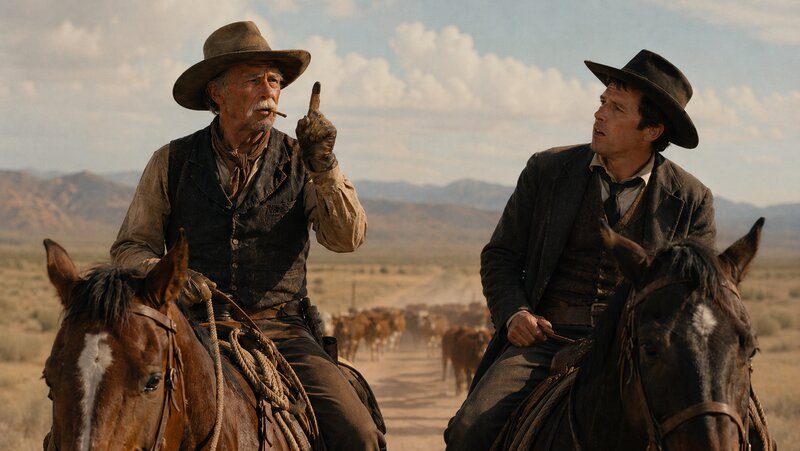
The sun sat low on the horizon, casting long, golden light across the open plains. Two riders moved in steady rhythm, the creak of leather and the soft clop of hooves the only sounds in the vast stillness.
Mitch, a city man in borrowed boots, turned toward the grizzled old cowboy beside him.
“You ever been in love, Curly?” he asked.
Curly kept his eyes ahead, reins loose, the silence stretching until his answer came.
“Once. Driving a herd across the Panhandle, I passed a little dirt farm. Out in the field, there was a young woman working in the sun. Prettiest thing I’d ever seen.”
Mitch leaned in. “What happened?”
“I turned my horse around and rode away,” Curly said.
Mitch blinked. “You what?”
“Figured it wouldn’t get any better than that.”
Mitch laughed in disbelief. “She could’ve been the love of your life.”
“She is,” Curly replied, without changing his steady pace.
They rode in silence until Curly finally asked, “You want to know the secret of life?”
Mitch nodded.
Curly held up a single finger. “One thing. You stick to that, and everything else don’t mean shee-it.”
Mitch frowned. “What’s the one thing?”
Curly smiled faintly. “That’s what you gotta figure out.”
A scene from the movie, "City Slickers." Curly’s choice had a cowboy nobility to it. You hear it in movies all the time but it is usually expected or cliche. Curly made it a paradox, almost biblical sounding. Curly understood something was gripping his innate sense of value. He knew he could not fulfill a promise to the young beauty,so he, for the good of the other, rode away.
This exchange reveals so much. A simple example but tells us a little of the nobility it represents. That innate goodness seemed to be a cornerstone in Curly's life. Mitch was confused because what a gritty old cowboy was talking about seemed contrary to his image. Curly believed it was the one thing Mitch could not be taught. One thing we must choose to live by to understand. One thing worth giving yourself to. One thing that controls all morality.
Jesus once said the same thing to Martha, who was weary with her many chores: “Only one thing is necessary” (). Life is filled with noise, demands, and distractions. But when you strip it down, there really is one thing that gives meaning to everything else.
Only one thing is necessary. Not success. Not comfort. Not even the thrill of romance. Something not obvious, not fleeting emotion, a choice, an action. Something obviously only human. It’s love, real love. Curly's love included pain, and sacrifice.
Not the love that comes and goes with mood or circumstance. Not the love that waits for the other person to earn it. I’m talking about the choice to give yourself for the good of another, whether or not it benefits you. The kind of love that changes how you see the world, how you spend your days, and how you define and refine your worth. It is a gritty, yet beautiful masterpiece that without the proper teacher never makes sense.
It’s the kind of love the ancients recognized as greater than mere affection or desire. The Scriptures whisper of it: “Greater love has no one than this, that someone lay down his life for his friends” (). This love is described in greek as agape.
The Rugged Nature of Real Love
This kind of love isn’t soft or sentimental. It’s rugged. It’s costly. It’s the kind of love that leaves scars.
We often imagine love as comfort, safety, or the thrill of affection. But real love does not protect us from pain, it exposes us to it. Real love demands that you stand in the gap for someone else, even if it costs you.
Think of the parent who works two jobs, not to climb some ladder of prestige, but simply to keep food on the table. There is no glamour in it. There is exhaustion, worn hands, lost opportunities, and a thousand quiet deaths to self. The world rarely applauds that sacrifice. Yet the child who grows up safe and nourished carries the hidden fruit of that love. Someone, a parent, made a choice maybe driven by emotion but also a choice life long. Why?
Now contrast this with the world’s measures of greatness: money, power, influence. These promise control and security, yet they never deliver peace. Wealth can crumble in a market collapse, power shifts with the tides of politics, and influence fades when the crowd finds a new idol to follow. “Naked a man comes from his mother’s womb, and as he comes, so he departs” (). Even the most powerful kings of history have died clutching the same empty hands as the beggar in the street. Death is the great equalizer, and no amount of fortune or fame can stand against it.
Agape, selfless love, is the only thing that stands unbroken in the face of death. It outlasts money, mocks power, and unmasks the fragile illusions of security we cling to. Those who have tasted it know there is a peace deeper than anything money can buy, a peace that doesn’t vanish in the grave but stretches beyond it.
This is why agape is not weakness, it is the ultimate strength. It dares to lose so that others may gain. It embraces the ugly realities of suffering, betrayal, and even death, and still chooses to give. The good, the bad, and the ugly all meet at the same crossroad. The world counts success by what you keep; agape counts it by what you give.
And the true end of agape is not defeat, but shalom, a peace so whole that it restores what was broken, heals what was wounded, and brings harmony even out of chaos. “The peace of God, which surpasses all understanding, will guard your hearts and your minds in Christ Jesus” ().
The ruggedness of love is not without reward; it is the only road that leads to the kind of peace every soul longs for but most spend their lives ignoring. Agape is not the peace of this world, fragile and fleeting. “Peace I leave with you; my peace I give you. Not as the world gives do I give to you” ().
When we discover it, we find the world’s noise falls silent, and what remains is life itself: the good, the beautiful, the peace.
The Choice of Agape
If this “one thing” is real, it cannot simply be a feeling. Feelings rise and fall, stirred by beauty one moment and lost in disappointment the next. Agape is not a feeling, it is a choice. Every decision should be preceded with how is agape affected, is this choice serving the greater good.
It is the steady decision to seek the good of another, even when it costs us. It is the willingness to set aside our own comfort, ambition, or recognition so that someone else may flourish.
Other forms of love, family affection, friendship, romance, are beautiful gifts, but they often rest on an unspoken contract: I will love you as long as you give me what I need. They rise and fall on conditions, circumstances, and reciprocity.
Agape, by contrast, tears up the contract. It does not ask what it will receive in return. It gives because giving is the nature of love itself.
This is why agape is not weakness, but strength. It is not sentimentality, but sacrifice. It is the love of Christ who “did not come to be served, but to serve, and to give his life as a ransom for many” (). The choice at times is extremely difficult and frequently causes turbulence in your heart but if you listen you will hear the whisper of confirmation. The knowledge of everything that can go wrong is trivial because you are loved. And that love, agape, includes peace.
The Invitation
If there really is one thing, one truth, one calling, one way of living that gives shape and meaning to everything else, what would happen if you found it?
What would change if your life were ordered around it?
What might fall away?
What might be reborn?
We’ll begin by facing the hard question of what remains when the “dirt” of wealth, power, and public persona falls away. For it is only when the heart is exposed that we can truly see what kind of love lives there.
Because the answer to Curly’s question is not only closer than you think, it may already be written into the deepest places of your soul. Are you ready to look?