When a Catholic Claim Needs to Go Back to the Church
A reflection on Eucharistic reverence, Communion in the hand, and the need to measure strong Catholic claims against what the Church actually teaches.
Published August 30, 2026
I was listening recently to Matt Fradd interview Fr. John Perricone on Pints with Aquinas. Fr. Perricone entered seminary in 1968, which immediately placed him in a period of Catholic life I remember well. As he described those years, much of what he said was familiar. For Catholics of our generation, the years surrounding and following the Second Vatican Council could be bewildering. Things we had been taught to regard with great seriousness changed very quickly. The appearance of the Mass changed. Traditions that had seemed inseparable from Catholic identity disappeared or were altered. There was confusion about authority, religious life, the sacraments, and sometimes even about how Catholics understood the Eucharist. Whatever judgment we make about that period now, the confusion many Catholics experienced was real. So I understood some of Fr. Perricone's frustration. I shared some of it.
Still, something in the conversation made me increasingly uncomfortable. There was a certainty in the telling that caused my own confirmation-bias alarm to go off. That does not mean Fr. Perricone was wrong, nor does it tell me anything about his intentions. It simply meant that I needed to listen more carefully. As the conversation continued, serious problems in the seminary were discussed, the aftermath of Vatican II was criticized, Pope Francis entered the discussion negatively, and at times Rome itself seemed almost to become part of the problem. Matt Fradd clearly respected his guest and rarely challenged the direction of the conversation. None of that by itself settled anything for me, but it made the next moment especially important.
Fr. Perricone then told a story about Mother Teresa. He said that while having breakfast with her he asked what, among all the terrible things she had witnessed, was the worst evil she had encountered. According to his recollection, she answered: “Communion in the hand.” He was surprised enough to ask her again, and he recalls her explaining it as a dishonor to Our Blessed Savior. Fr. Perricone has since stood by that recollection, so there is little reason for me to build an argument around the possibility that he has now changed what he says happened.
And yet that was exactly where the interview became most useful to me.
I could believe that Mother Teresa said it. Her reverence for the Eucharist was profound, and I can easily imagine her speaking very strongly about anything she believed diminished that reverence. I did not know whether there had been some additional context, whether she was speaking about abuses she had witnessed, or whether she meant precisely what Fr. Perricone understood her to mean. But for the question before me, I realized something important: I did not need to know.
I needed to know what the Church teaches.
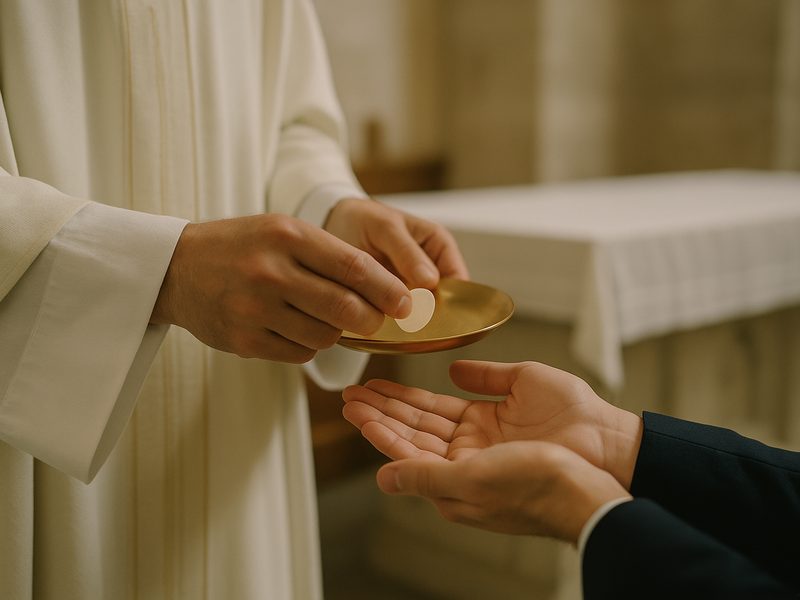
The Church permits reception of Holy Communion in the hand. In the United States the communicant may choose to receive the consecrated Host either on the tongue or in the hand, and the Vatican's instruction Redemptionis Sacramentum specifically recognizes reception in the hand wherever the bishops' conference has received the approval of the Apostolic See. The Church demands profound reverence and places safeguards around reception, but the practice itself is permitted by the Church.
That settled what needed settling for me.
It did not tell me that receiving on the tongue and receiving in the hand are identical in every historical, devotional or prudential respect. Catholics may certainly believe that one better expresses Eucharistic reverence. Mother Teresa was free to hold a strong opinion about it. Fr. Perricone is free to share that opinion. But neither my opinion, a priest's opinion, nor even the opinion of a canonized saint can transform an act expressly permitted by the Church into a sin simply by declaring it one.
So I did something simple.
I put the statement down.
I did not need to disprove Mother Teresa. I did not need to accuse Fr. Perricone of dishonesty. I did not need to become angry with Matt Fradd for failing to challenge him. I didn't even need to solve the historical question of exactly what was said at that breakfast decades ago. I had taken the claim back to the Church, and the claim, at least understood as declaring the approved practice itself sinful, could go no farther.
And strangely enough, that day's Gospel gave me Peter.