The Fear That Makes Wars
A sober reflection on U.S.–China rivalry, the danger of fear-driven conflict, and the moral responsibility to pursue strength, restraint, and peace.
Published July 1, 2026
The Fear That Makes Wars
On the evening of August 5, 1971, men in Washington drew capsules from a drum, and the numbers they read aloud told a generation of nineteen-year-old boys whether they would be sent to kill strangers in a country most of us could not have found on a map five years earlier.
I was one of those boys. Born in 1952, which made that drawing mine. My number was 304 — high enough that the call would never come. But by then the number was almost beside the point. I had already decided, and filed the papers to say so, that I would not go. Conscientious objector. It is a strange phrase to carry at nineteen, when you are not entirely sure what you believe about anything else. But I was sure about that.
What I could not have told you then — what took me fifty years to see clearly — was why that war existed at all. Not the official reasons. The engine underneath them. Vietnam was not built on ambition. Nobody in Washington wanted rice paddies. It was built on fear. Fear of falling dominoes, fear of looking weak, fear that if we did not fight communism there we would fight it here, fear so total that it became a kind of national religion, demanding sacrifice and forbidding questions. Fifty-eight thousand American names on a black wall, and something like two million Vietnamese dead, because fear told two great powers a story about each other and both of them believed it.
I have been thinking about that lately, because I hear the story starting again.
---
Twenty-four centuries ago, a Greek historian named Thucydides sat down to explain why Athens and Sparta had torn the Greek world apart. His answer has haunted strategists ever since: "It was the rise of Athens and the fear that this instilled in Sparta that made war inevitable."
Read that sentence slowly. He does not say ambition made war inevitable. He does not say wickedness did. He says fear did. Political scientists now call this the Thucydides Trap: when a rising power threatens to displace an established one, war becomes dangerously likely — not because either side chooses catastrophe, but because fear, pride, and miscalculation choose it for them. The danger is not only ambition. The danger is panic.
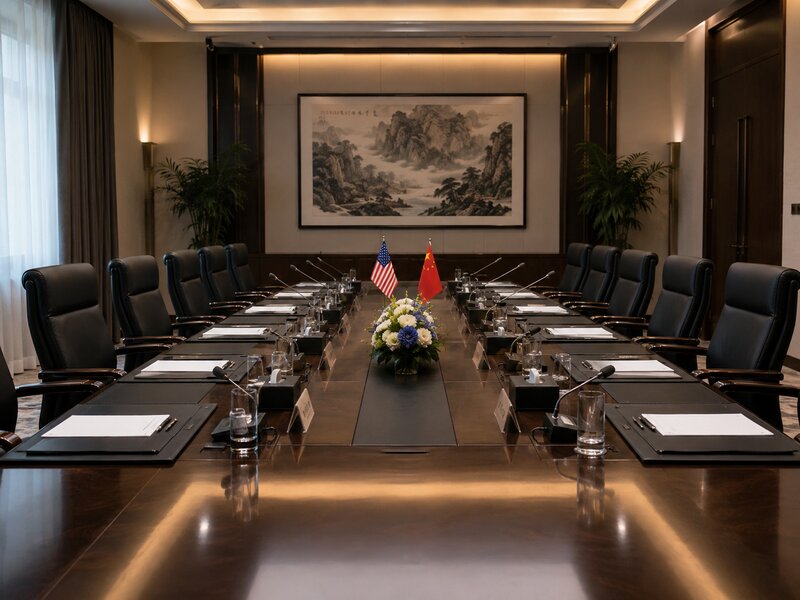
Today the phrase is invoked almost exclusively about the United States and China, and for good reason. China's rise over the past four decades is one of the most consequential facts of our lifetime. The question is not whether China has risen; it has. The question is whether that rise must end in confrontation — and whether a country like ours, which has walked into fear's trap before, can recognize the door this time.
---
History gives us reason to be sober. Athens and Sparta did not stumble into war in a day. Their conflict grew from alliance systems, proxy fights, commercial rivalry, and a slowly hardening conviction on each side that the other's security meant its own vulnerability. Smaller states dragged larger ones into their quarrels. Honor became inseparable from strategy. What might once have been avoided came to feel unavoidable — and the feeling of inevitability did half the work of making it so.
Britain and Germany replayed the pattern before 1914. Naval buildups, entangling alliances, nationalist fever, and a cascade of diplomatic failures turned the murder of one archduke into a catastrophe that consumed a generation and set the fuse for a second. Fear hardened into fatalism, and fatalism into artillery.
And yet — this matters — the trap is not a law of nature. The United States surpassed Britain economically without ever fighting Britain for world leadership. The Cold War was dangerous, costly, and morally compromising in a hundred ways, but the superpowers never fought each other directly; deterrence, diplomacy, arms control, and a grim recognition of mutual destruction held. Human beings are not prisoners of historical patterns unless they surrender moral imagination. Thucydides wrote a warning, not a prophecy.
---
So let us look at China with clear eyes, neither flinching nor panicking.
The rise is real. China is the world's second-largest economy — by some measures the largest — and the manufacturing heart of the planet, producing a staggering share of its electronics, batteries, solar panels, and industrial goods. It has lifted hundreds of millions out of poverty, built infrastructure the West can only envy, and become a genuine competitor in artificial intelligence, telecommunications, electric vehicles, and green energy. Its navy is now the world's largest by ship count. Its missiles, cyber capabilities, and nuclear modernization are designed, quite openly, to make American military intervention in Asia too costly to attempt. Its pressure on Taiwan, its militarized outposts in the South China Sea, its border clashes with India — these have made its neighbors anxious for reasons that are not imaginary. And through the Belt and Road Initiative and a patient courtship of the Global South, Beijing offers itself as champion of a "multipolar" world to nations with long and legitimate memories of Western hypocrisy.
China's leadership does not want to be admitted to an American-led order on American terms. It wants influence commensurate with its size, its history, and its ambitions. It would be naïve to pretend otherwise.
But it would be equally naïve to assume that rise guarantees dominance. China's population is aging fast and its workforce shrinking. Its property sector — long the engine of its growth — has shown deep structural rot. Local government debt is crushing. Youth unemployment has been serious enough that the government stopped publishing the worst numbers. And its political system, so good at mobilizing concrete and steel, is also good at suppressing bad news, punishing independent thought, and strangling the very openness that innovation requires. Meanwhile the neighbors are not lining up to be ruled: India treats China as a rival, Japan is rearming, Australia learned about Chinese economic coercion the hard way, the Philippines has pulled closer to Washington, and Vietnam — communist, intertwined with China, and possessed of two thousand years' practice resisting Chinese domination — remains Vietnam.
The United States, for its part, retains enormous advantages: alliances no rival can match, global military reach, energy abundance, the dollar, the universities, the innovation ecosystem, and a culture that at its best still draws talent from every corner of the earth. America's greatest dangers are not Chinese. They are internal — division, dysfunction, inequality, the collapse of civic trust, and the old imperial temptation to confuse dominance with leadership.
---
Here is where the trap actually closes: not in any single fact above, but in what fear does with the facts. The danger is that both nations come to read every move by the other as hostile, every technological gain as existential threat, every regional dispute as a test of honor, every compromise as weakness. I watched my country do this many more times since I was nineteen. Each time the government becomes a little less trusted and our freedoms strained.
Two false comforts must be refused.
The first is complacency — the belief that China's internal troubles mean we needn't take it seriously. This is dangerous. Nations can be internally strained and externally powerful at once, and a regime that fears its window is closing may become more risk-tolerant, not less. Weakness does not always produce moderation. Sometimes it produces nationalism with a deadline.
The second is fatalism — the belief that war is coming because history says so. This is worse, because it is self-fulfilling. Leaders who believe conflict is inevitable stop investing in diplomacy, overmilitarize everything, demonize whole peoples, and treat restraint as betrayal. The expectation of war becomes one of war's causes. I remember what it sounds like when a country talks itself into that expectation. It sounds reasonable. It sounds like prudence. Right up until the drums.
The better path is neither appeasement nor aggression. It is disciplined peace — strength, humility, and clarity held together at once, which is harder than any of them alone.
Strength, because unchecked coercion invites more coercion. The United States and its allies should maintain credible deterrence in the Indo-Pacific, especially around Taiwan and the sea lanes. Deterrence is not warmongering when its purpose is to prevent war; a balance of power can create the very space in which diplomacy breathes.
But deterrence without diplomacy is a loaded weapon in a dark room. Washington and Beijing need sustained channels of communication — between militaries, diplomats, crisis managers — so that an accident at sea or in the air does not become a spark in dry grass. They need mechanisms for managing cyber conflict, nuclear risk, artificial intelligence, and space. They need to speak even when they distrust each other. Especially then.
Economics requires the same balance. Reducing dangerous dependencies in semiconductors, pharmaceuticals, rare earths, and defense supply chains is simple prudence. But total decoupling is a fantasy that would impoverish ordinary people on both sides while deepening hostility. Selective de-risking, not a new iron curtain. Trade can be a channel of exploitation; wisely governed, it can also be a restraint on war.
And human rights must not be bartered away for stability. The treatment of the Uyghurs, the repression of Hong Kong, the surveillance state, the pressure on dissidents — these deserve honest naming. But moral clarity must be surgically separated from hatred. Criticizing the Chinese Communist Party is not despising the Chinese people, and a West that tolerates the scapegoating of Asian communities has already lost the argument it claims to be making. A foreign policy that dehumanizes cannot defend human dignity.
Taiwan remains the most dangerous flashpoint on earth: a vibrant democracy of more than twenty-three million people, indispensable to global semiconductor production, and bound up with Beijing's deepest questions of identity and legitimacy. Help Taiwan defend itself; avoid symbolic provocations that add heat without adding security; make certain Beijing understands what an invasion would cost; and preserve the ambiguity and patience that have kept the peace for decades. The goal is not to win a point. The goal is to prevent a forced outcome and protect human life.
Finally — and I believe this more with every year — this contest will not be decided by military budgets or speeches about freedom. It will be decided by whether America becomes worthy of trust. Repair the institutions. Invest in the young. Welcome the immigrant and the innovator. Reduce the corruption. And abroad, offer the nations of the earth something better than warnings about China: roads, ports, hospitals, debt relief, respect. Most countries do not want to choose between Washington and Beijing. They want partnership rather than patronage. If we want influence, we must listen as well as lecture, and confess our own failures while we are at it. An order that is merely anti-China will fail. Only an order that is genuinely pro-human deserves to succeed.
---
I said I would come back to the boy with the draft card, and here is what he has to say, fifty-five years on.
Here is the thing the strategists keep missing, the thing I have watched confirm itself across seven decades. America is not admired because of our vast power and our ability to dominate. Aircraft carriers do not make anyone love us. Every empire in history had force; force is the most common thing in the world. What America has — when America is being America — is something rarer.
"We hold these truths to be self-evident, that all men are created equal, that they are endowed by their Creator with certain unalienable Rights, that among these are Life, Liberty and the pursuit of Happiness."
America's power is in our liberty, and liberty is not our invention. It is a gift from our Creator — the Declaration says so in its first breath. It is the thing that is difficult to describe but easily recognized, the way you recognize a face. A farmer in a village on the other side of the world may never read our Constitution, but he knows the difference between a country that controls its people and a place where freedom is on open display. He knows it the way everyone knows it. People do not risk their lives on rafts to reach the country with the biggest navy. They risk their lives to reach the country where they can speak, worship, argue, build, and raise their children without asking permission.
That is the contest with China, stated honestly. Not whose economy is larger. Not whose missiles fly farther. It is a contest between control and liberty, conducted in full view of a watching world — and it is a contest we can only lose by abandoning the gift. Every time we surveil like our rival, censor like our rival, scapegoat like our rival, or let fear talk us out of our own founding, we hand Beijing a victory no fleet could win for them. The surest way to defeat a system built on controlling people is to remain, visibly and stubbornly, a people who are free.
Which brings me back to fear, because fear is how the gift gets surrendered. The Thucydides Trap is finally not a question of strategy. It is a question of what fear does to the soul of nations. Fear can be useful when it awakens prudence. But fear becomes idolatrous when it demands total loyalty, excuses cruelty, and convinces us that the neighbor across the water is only and entirely a threat. Nations, like men, can become possessed by rivalry. They lose the ability to see children, workers, elders, believers, artists, and families on the other side of a border. They reduce a billion image-bearers of God to a single enemy symbol — and I have seen what a country will permit itself to do to a symbol.
Agape and shalom call us to something harder than passivity. Love is not naïveté, and peace is not surrender. True peace requires justice, truth, courage, and restraint together: defending the vulnerable without delighting in enmity, naming aggression without becoming addicted to confrontation, preparing for danger while laboring with all our strength to prevent it. And it requires remembering that the truths we hold are self-evident to everyone — that the Creator who endowed Americans with unalienable rights endowed the Chinese people with the very same ones. Liberty is not our possession to hoard. It is a gift we were given so the world could see what the gift looks like.
War between the United States and China would be a tragedy beyond calculation — economies devastated, millions endangered, escalation that no leader could promise to control. Preventing such a war is not weakness. It is one of the great moral responsibilities of our age, and it will be discharged, or failed, by choices — not by metaphors, and not by fate.
Great powers often sleepwalk toward disaster while insisting they are merely protecting themselves. I was nearly conscripted into one such sleepwalk. I declined then, and I decline now. The trap is real.
So is the gift.