The President Who Promised to Stop Wars
A Catholic reflection on presidential promises, the Iran war, the cost of pride, and the demands of agape in the use of power.
Published July 24, 2026
The war with Iran is becoming a test not only of American power, but of whether Donald Trump can place truth, humility, and the good of others above his own image.
News Lens | July 24, 2026
On election night in November 2024, Donald Trump made one of the clearest promises of his campaign:
“I’m not going to start wars. I’m going to stop wars.”
It was not an obscure remark buried in a policy paper. It was delivered during his victory speech, when a newly elected president tells the country what kind of presidency it has chosen. Throughout the campaign, Trump presented himself as the alternative to the interventionists, the neoconservatives, and the permanent foreign-policy establishment. He told Americans that strength would prevent wars, negotiation would end them, and his unpredictability would keep adversaries cautious.
Many Americans believed him.
Americans were tired of the whole political system breakdown. The selfish interests. The wars. The swamp really did need drained. Americans were willing to overlook the pompous behaviours from a leader that would truly "Make America Great Again." The message was plain but effective.
Trump seemed to understand that exhaustion.
Now the United States is nearly five months into a widening war with Iran.
American forces are again striking targets across Iran. Iran is attacking American bases in neighboring countries. The Strait of Hormuz has been severely disrupted, Houthi forces have opened another front against shipping in the Red Sea, and oil prices have again crossed $100 a barrel. At least 18 American service members have been killed and more than 430 wounded. By late July, the direct cost to the United States was estimated at approximately $37.5 billion—and the conflict still had no certain conclusion.
This is no longer a threatened military action, a single retaliatory strike, or a brief show of force.
It is a war.
A Promise Rewritten After the Fact
When Trump was recently confronted with the contradiction between his campaign and the Iran war, he responded:
“I didn’t guarantee no war.”
That is a way to avoid truth. War deserves more the flippancy.
A president cannot make a promise before an election, benefit from the public’s trust in that promise, and then redefine it after the bombs begin falling. Trump also argued that he opposed only “endless wars” and that the Iran conflict would not become one.
But every endless war begins as a short war.
Every administration promises clear objectives. Every military campaign is described as limited. Every president assures us that the enemy is weaker than expected, victory is close, and negotiations will soon follow.
On March 9, Trump said the Iran war was already “very complete.” On March 31, he said it could be finished within two or three weeks. In May, he said it would end “very quickly.” Yet by late July, the United States was launching new attacks, Iran was striking American positions, and Trump was threatening still greater military punishment.
Playground diplomacy and juvenile excuses make for poor political strategy. Adults may excuse such behavior in a child, but in a democracy they will hold a president accountable.
Iran Is Dangerous, That Does Not End the Argument
Iran’s government is repressive, violent, hostile to the United States, and deeply involved in supporting armed groups throughout the Middle East. Its nuclear ambitions, missile programs, attacks on shipping, and threats against American forces cannot be dismissed.
Acknowledging that reality does not require surrendering judgment to the president.
In a time of war, past presidents would seek coalitions. Soliciting support for their actions in case of troubles. They wouldn't plunge the country into war and resort to "name calling" reluctant participants, threaten them with tariffs, than proceed into war.
The Constitution did not make the president a king whenever he speaks the word “security.”
On July 23, the House voted 214–208 for a resolution directing an end to unauthorized military action against Iran. Four Republicans joined Democrats. The measure was largely symbolic because of the Senate’s resistance and the likelihood of a presidential veto, but it exposed a growing fact: even members of Trump’s own party are questioning whether the country has been drawn into war without the consent and accountability the Constitution requires.
The president may command the armed forces. He does not own them.
Their lives are not instruments for protecting a political reputation.
The War Has Already Reached American Homes
The battlefield is not limited to Iranian airspace or the waters of the Persian Gulf.
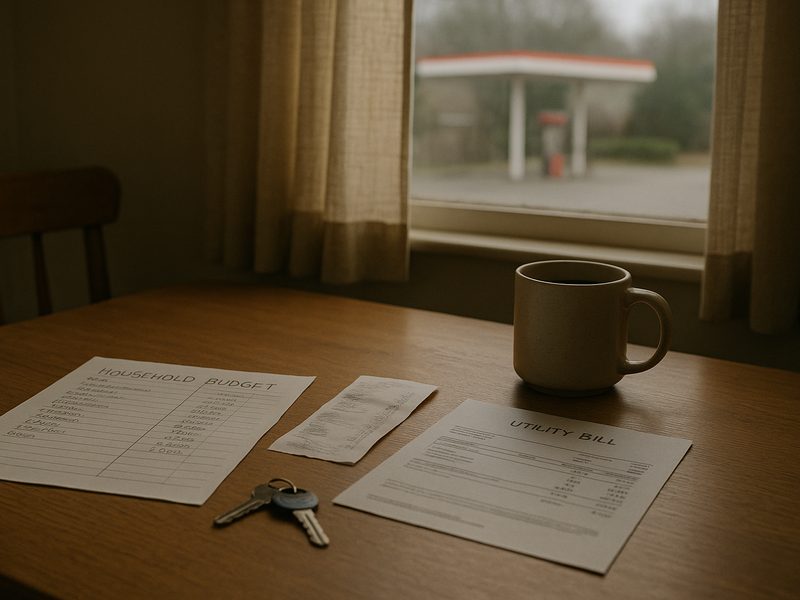
It reaches the American family through gasoline, electricity, food, transportation, mortgages, retirement accounts, and federal borrowing costs.
Disruptions in the Strait of Hormuz and the Red Sea have threatened two of the world’s most important energy corridors. Insurance costs have risen, tankers have been rerouted, and oil has traded above $100 a barrel. Higher energy prices flow into nearly everything Americans buy. They also make inflation harder to control and constrain the Federal Reserve’s ability to lower interest rates.
Trump has suggested that oil and gasoline will “drop like a rock” when the war ends. Futures prices could certainly fall quickly on a credible peace agreement. But the physical damage cannot be undone by a press conference.
Oil removed from inventories must eventually be replaced. Strategic reserves must be rebuilt. Tankers must be repositioned. Damaged infrastructure must be repaired. Refineries must secure dependable supplies. Shipping insurers must believe that the waterways are safe.
Peace could stop the bleeding. It cannot instantly restore the blood already lost.
The United States is also attempting to finance enormous federal deficits while paying for another war. If foreign governments reduce their purchases of Treasury securities, American taxpayers will still obtain the financing—but perhaps at substantially higher interest rates.
China does not need to destroy the American economy. It would not want to destroy one of its largest customers. Nor is there public evidence proving that Beijing has coordinated a campaign to manipulate American elections through oil and Treasury markets.
It does not need such a conspiracy.
China, Russia, Iran, and other rivals need only recognize the weakness America has created for itself: enormous debt, dependence on global energy prices, political sensitivity to inflation, and a president who often responds to resistance with louder threats.
They need not defeat the United States on a battlefield. They can allow the United States to exhaust itself proving that it cannot be intimidated.
That is one of the oldest traps in history. The rising power tests the established power. The established power treats every challenge as a test of prestige. Neither side believes it can afford to step back. Pride converts manageable disputes into existential contests.
The United States can win every airstrike and still lose strategic ground.
The Political Cost of the President’s Mouth
Trump’s language is not separate from his foreign policy. It is often the instrument that drives it.
He threatens total destruction, unconditional surrender, massive punishment, tariffs, sanctions, retaliation, and humiliation. Such words may briefly frighten an opponent. They may also close the door through which that opponent might retreat.
Diplomacy requires leaving one’s enemy a path toward a settlement that does not require public self-destruction. Trump often treats that as weakness because he understands negotiation primarily through victory, dominance, and personal status.
But nations are not real-estate contractors. They absorb punishment differently. They remember humiliation for generations. Their leaders may accept extraordinary suffering rather than appear to submit to a foreign ruler.
A president’s mouth can therefore become a weapon aimed in both directions.
It wounds the adversary, but it also limits America’s choices. Once the president has promised overwhelming punishment and complete victory, compromise begins to look like personal defeat. American soldiers may then be asked to continue fighting not because the nation lacks alternatives, but because its leader cannot tolerate appearing to have backed down.
That is not strength.
It is captivity to pride.
The Agape Question
Agape is not passivity. It is not sentimental affection, political politeness, or a refusal to confront evil.
Agape may require force to protect the innocent. It may require courage, sacrifice, discipline, and judgment. But it always asks a question that power prefers to avoid:
Whose good am I seeking?
Is the president seeking the good of American service members and their families?
The good of civilians living beneath American bombers?
The good of Iranian people trapped beneath a brutal government?
The good of American families struggling to pay for gasoline, food, housing, and debt?
Or is the objective increasingly the preservation of one man’s image as the strongest man in the room?
Agape does not demand that Donald Trump become weak.
It demands that he become humble enough to understand that strength is given for the protection of others, not the glorification of oneself.
It demands truthfulness about what was promised and what has been delivered.
It demands the courage to admit that a strategy has failed.
It demands the wisdom to accept an imperfect peace before more young people die pursuing the illusion of a perfect victory.
It demands that the president recognize something every Christian must eventually confront: being forced to retreat from pride is not humiliation. It may be salvation.
A Prayer, Not a Curse
I cannot pray for Donald Trump’s destruction.
I cannot pray that war, economic suffering, impeachment, or electoral defeat will punish him. To desire another person’s ruin would violate the very principle by which I am attempting to judge him.
I can pray that he will be humbled before more graves are opened.
I can pray that he will remember the Americans who believed him when he said he would stop wars.
I can pray that he will understand that leadership is not measured by how effectively a man humiliates his enemies, but by how faithfully he protects those entrusted to him.
And I can pray that he will finally understand agape:
Your good matters to me—even when acknowledging your good requires me to surrender my pride.
That would not make Donald Trump smaller.
It might finally make him a peacemaker.