
The Measure of Agape
A personal reflection on humility, mercy, and the measure of agape: how we respond when we are under pressure.
Published July 29, 2026
The More He Reacts Like Jesus
Prior to the last election, I kept watching for one thing: truth.
All we got were distractions and division, like magicians directing our attention elsewhere while the real problem went untouched. Americans did not need more confusion. We needed truth, and we needed some way back toward unity. Instead, MAGA promised to make things as they once were. To me, that looked like more war, deception, and corporate immunity at the cost of freedom—the same habits that helped leave us trillions of dollars in debt. The left offered its own deceptions, groping for a candidate who seemed less like a leader than a pawn in a democracy already frayed and failing.
Here is the measure, stated as plainly as I know how: the more he reacts like Jesus.
Now let me tell you the story.
Butler
I was hopeful before the 2024 election. I will admit that plainly. I hoped Donald Trump had learned something from his first term. Four years out of power is a long time and hardship can humble a man. I thought it was possible. After all, Trump did have a legacy. Which icon would Trump worship, money or truth.
I had already come to believe that the deepest problem in this country was not the one either party was campaigning on. The problem was division. I have seen it before. I am old enough to remember the country tearing itself apart over Vietnam, and I carried a conscientious objector’s card through the middle of it. Left against right. Religion against religion. The woke movement and the backlash against it. War abroad feeding anger at home. All of it keeps us from coming together. Jesus warned about a house divided against itself long before Lincoln used the image.
Then came Butler, Pennsylvania, on July 13, 2024. A bullet passed close enough to Trump’s head to draw blood. He came very close to dying on that stage.
I want you to understand what I was hoping for in that moment. Not politically, but spiritually. When a man comes that close to eternity, we hope something changes in him. The old-timers called it being sobered. Scripture connects the fear of the Lord with the beginning of wisdom. I watched my television hoping to see a humbled leader—a man who might look at a fractured country and decide that he did not want to leave it more divided than he found it.
Instead, I saw a raised fist and heard the word “fight.”
He was not entirely wrong. We did have a fight on our hands. We still do. But the enemy was not a visible army. The enemy was division itself, and division cannot be defeated by striking back harder. That fight required humility, the one weapon that never seemed to enter the arsenal. What I saw that day was more defiance, delivered with a bloodied ear and a clenched fist, while the crowd roared.
I Kept Watching
I did not give up right away, and I want to be fair about why. Maybe the raised fist was a reflex. A man gets shot at, adrenaline takes over, and the body moves before the soul catches up. I have said things in the heat of a moment that did not represent my better self. If God judged me only by my first reactions, I would be in trouble. So I kept watching. I told myself that the humbling might come later, in the quiet, where it often does.
I did not see it. What emerged from that day seemed to be a more boisterous man, not a more sober one. The near miss became a rally story and a sign of destiny rather than, as I had hoped, a summons to repentance. I watched for months and finally let go of that hope.
But I need to be careful, because this could easily be read as a partisan piece, and that is not my intention. I could not vote for the other side either. Its divisiveness was often quieter and dressed in gentler language, but I believed it was still there. The whole election felt like a shell game. A party can speak of unity while sorting people into opposing categories, and that does not heal a country. It can become the same disease with a better bedside manner. I stood before that ballot like a man facing two doors that seemed to open onto the same hallway.
So I voted the way I voted, and I remained somewhat hopeful. Watchful. That has been my posture for most of my adult life: watching leaders and waiting to see whether power will humble a man or finish him.
The Funeral
Then Charlie Kirk was assassinated.
Whatever anyone thought of his politics, a young husband and father was murdered in front of a crowd for speaking his mind. That was evil. I grieved it, and I watched the aftermath as I had watched Butler, looking again for some sign of sobriety.
A funeral is one of the few places left in American life where partisanship ought to lay down its arms. I have buried enough people to know what a funeral is for. It is for grief, gratitude, prayer, and the terrible reminder that every one of us will return to dust. I hoped for a sober farewell.
Instead, I saw banners, a stadium production, and pomp.
Then, in the middle of it, I saw something else—something so different from the spectacle around it that it nearly broke my heart. Erika Kirk, the widow, publicly forgave the young man accused of murdering her husband. She connected that forgiveness to Christ and to what she believed her husband would have wanted.
That was a hope-filled mark of agape. It was a woman trying to react like Jesus at the worst moment of her life. It called to mind Christ asking the Father to forgive those crucifying Him (). Her act of mercy seemed almost out of place amid the spectacle, like a pearl dropped in the middle of a rally. It was the truest Christian act I saw that day, and the stage nearly swallowed it.
Then President Trump spoke. He appeared energized, as though he had entered a campaign rally rather than a memorial. He spoke of himself, his enemies, and his hatred for his opponents. He drew a contrast between his own response and Charlie Kirk’s willingness to forgive.
I have watched American presidencies since Eisenhower. For me, that was one of the lowest moments. I do not mean the most criminal or the most incompetent. I mean low in a spiritual sense. The contrast could hardly have been clearer: a widow had just offered forgiveness, and a man with power answered by speaking of hatred. The crowd cheered.
How You Recognize Agape
Now I come back to where I started, because this article is not finally about Donald Trump. He is part of the story. The question is larger:
How do we recognize someone who understands agape?
My answer is this: the more he reacts like Jesus.
Not talks like Jesus. Not quotes Jesus. Not holds up a Bible for the cameras. Reacts. Agape shows itself under pressure, in what comes out of us when we are squeezed. Erika Kirk was under a pressure most of us can barely imagine, and what came out of her was forgiveness. That is what stayed with me. It gave me hope.
What does reacting like Jesus mean in practice? The Church has given us a concrete guide in the corporal and spiritual works of mercy. Christ’s teaching in Matthew 25 calls us to feed the hungry, give drink to the thirsty, welcome the stranger, clothe the naked, care for the sick, and visit the imprisoned. The spiritual works of mercy call us, among other things, to forgive injuries, bear wrongs patiently, comfort the sorrowful, and pray for the living and the dead.
Look at those works again and notice what they require. Each one asks us to look at another human being—including an enemy, a stranger, or a prisoner who may deserve his sentence—and see a person made in the image of God. Not merely an opponent. Not a demographic. Not one of them. A person whom Christ loves and for whom He died.
The works of mercy are not extra credit for unusually religious people. They must become part of our lives, practiced until mercy begins to shape our first response. That is part of the long work of discipleship.
And here is the hard part, the part that helps me understand what I watched over those two years: mercy requires humility. There is no proud path to it. The temptation of pride runs through the story of the fall and through every human heart. It tells us to raise the fist, name our enemies, strike back, and enjoy the roar of the crowd.
Christ gives us another way. He tells His disciples to deny themselves, take up their cross, and follow Him (; ; ).
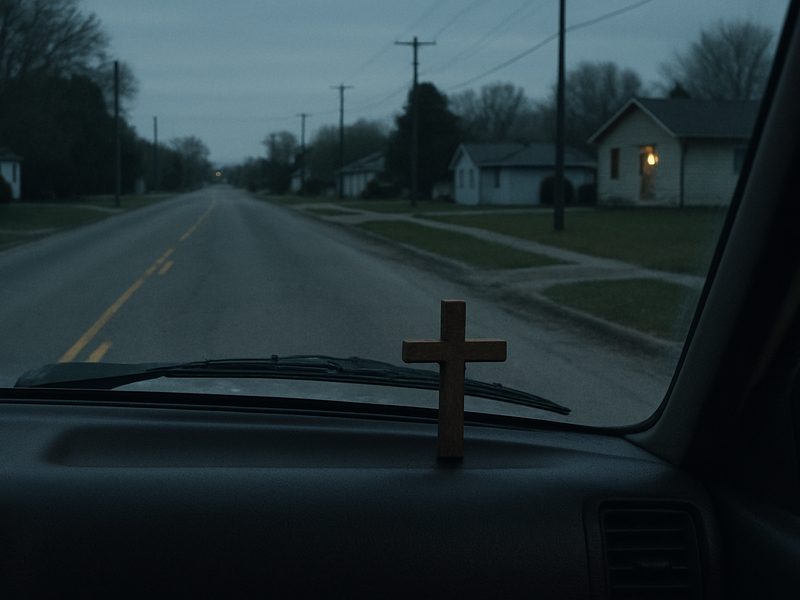
Deny yourself. Not promote yourself, brand yourself, or avenge yourself. A cross is not a weapon to swing at an enemy. It is a burden accepted in love. The fist and the cross are two very different postures, and I do not think we can hold both at once. Our hands are not built for it.
I spent two years watching a president, waiting for him to choose the cross. That was time I should also have spent watching myself.
I have a fist too. I raise it at the television, at the other party, at drivers on Route 41, and at people I have decided are the problem with this country. The division I diagnosed in the nation also lives in me, and my own cross is heavy. I can only imagine what a public leader must face and the temptations surrounding him. These times may demand more than a human being can bear alone. A leader today must anchor every decision in something greater than himself.
Look for that in your leaders, yes. But practice it in your kitchen, your church, your comment section, and your grief.
To future leaders, I would say: think about Christ. A simple man, scourged, beaten, and crucified, who prayed for the forgiveness of those crucifying Him (). Such mercy is impossible without divine assistance.
The more we react like Jesus, the more clearly the world can see what agape means. Somebody has to show them. It might as well begin with us.