
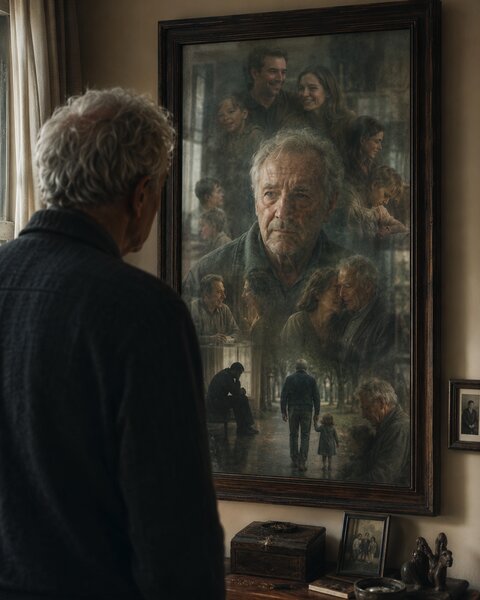
Apologia Generationis Nostrae
A personal confession about gratitude, prosperity, and the ways a generation may have passed by its neighbors’ suffering.
Published July 31, 2026
An apology to our children
I remember driving to the hospital after my mother had been admitted for surgery. I should have been thinking about her and praying for her. Instead, I was nearly panicked by the demands of the day. In my mind, her need had become another interruption between me and my next appointment.
As I pulled into a parking space, my car bumped the vehicle beside me and broke its taillight. I ignored it and kept going. I hurried in to visit my mother, and then I hurried away.
My mother needed her son. The owner of the other car deserved honesty. Christ was present in the interruption, and I was too busy to acknowledge Him.
I owe our children an apology.
This is a small example, but it is true. I could offer hundreds more, some far more serious, especially the wrongs I committed against my family and the ways I misused the blessings God had given me. But this article is not only about my sins. I believe it is also about the sins of a generation — though I cannot speak for everyone. I can speak for myself, and I do not believe I was alone.
My generation received blessings we did not earn. We inherited opportunities, wealth, influence, security, and comforts that earlier generations could scarcely have imagined. We benefited from sacrifices we did not make and from institutions we did not build. Too often, we did not stop to thank God. We asked for more, and when more came, we treated it as though it belonged to us alone.
We said that we loved God. Many of us went to Mass on Sunday. But during the week, we could pass by a suffering neighbor without allowing that suffering to interrupt our plans. We separated worship from the way we used our time, money, and power. We became skilled at protecting what we had while overlooking those who had little.
We had more than enough, yet we remained afraid of not having more. We used money to insulate ourselves from need — our own and everyone else's. We allowed neighbors to suffer within sight of our homes, churches, and places of work, and often noticed suffering only when it threatened to enter our own lives. Even then, we were tempted to treat the person in need as a problem to be managed rather than a brother or sister to be loved.
The magnitude of our neglect cannot be measured only by what we did. It must also be measured by what we failed to do with all that had been entrusted to us. We had time, but acted as though every interruption were an offense.
The story of the Good Samaritan has become harder for me to hear as I have grown older. The wounded man lay beside the road while others passed him by. The Samaritan allowed another person's suffering to change his journey. He stopped, drew near, and accepted the cost of mercy ().
I did not stop. I kept moving.
Christ warns in Matthew 25 that what we do, or fail to do, for those in need is bound up with what we do, or fail to do, for Him. That teaching does not allow me to claim love for God while remaining indifferent to the person beside me. The First Letter of John makes the same point with moral clarity: love of God cannot be separated from love of the brother or sister we can see ().
Sunday worship matters. The Eucharist is not a minor part of life or a weekly religious duty to be checked off. But if I receive Christ and then refuse to recognize Him in the people He places before me, there is a division in the way I am living. Saint James warns against a faith that speaks kindly to those in need but does nothing for them ().
For many years, I did not understand how deeply selfishness had shaped me. I wanted enough money and influence to control my life and protect my plans. I did not ask often enough what those gifts were for. I did not ask whether I was using them for God's glory or only for my own comfort and importance.
I mistook abundance for approval. I treated prosperity as proof that I was doing well, even while people near me were wounded and the poor were kept at a safe distance. Perhaps that was one of the great failures of our generation, too: claiming God's blessings without accepting the responsibility that came with them.
I apologize first to my own children. I used to say that my priorities should be God, family, and work, in that order, but I rarely lived that way. Sometimes God was not on the list at all. Work was always there, usually at the top.
As I have grown older, it has become easier to see the folly of giving work such importance. Work mattered, but I allowed it to take the place that belonged to God and my family.
By the time Christ's mercy finally reached through my defenses, I had already hurt many people. I cannot undo all of that. I can admit it, repent of it, make amends where I can, and ask forgiveness from God and from those I failed.
To our children — and I mean ours, the ones who will read this with our faces in mind: do not repeat our mistake. Do not confuse prosperity with goodness, activity with faithfulness, or Sunday attendance with a life of agape. Do not let ambition make another person's need seem like an inconvenience. Give thanks for what you receive, and ask what God intends you to do with it. Let love interrupt you.
This is the prayer I should have prayed much earlier:
I have to give thanks I know in my heart that money or power would have been my downfall. I have seen many wealthy who live in chaos and uncertainty. I own almost nothing now, no house, little money; and if I lived on the street I would still have debt to pay and thanks to give for His great blessings. His love, my family. Agape et Shalom.
For our children, I would leave these plain instructions:
- Give thanks before asking for more.
- Ask what your money, influence, and opportunities are for.
- Do not let worship end when Mass ends.
- Pay attention to the person whose need interrupts your plans.
- Admit the harm you have done, make amends where you can, and seek forgiveness.
- Measure what you have received by what you are able to give in love.