About Agape et Shalom
A personal account of conscience, faith, and the words “Agape et Shalom” that became a lifelong call toward the meaning and challenges of selfless love and peace.
Published June 15, 2026
Agape et Shalom — Where It Began
I was seventeen, Catholic by upbringing, but restless and questioning nearly every belief I had been handed. At that age, I thought I understood enough about the world to bend it to my own use. Then came the first great obstacle: the draft.
The turmoil had been building since 1968, the most turbulent season of my young life. Cities burned with riots. Antiwar protests filled the streets. Presidents and leaders were assassinated. Vietnam raged on every television screen. Each night the news delivered the body count like a grim drumbeat. Everyone seemed to have a side: the hippies railing against authority, my father carrying the pride of a World War II veteran, my mother standing firmly against the war. Where did I belong?
Registering was not a choice. Every boy my age had to face that question: Who am I, and what will I do when called? Would I follow the protestors, slip north into Canada, and live branded a coward? Would I march behind my father's war stories, even though my conscience resisted? Or was there another path?
When the time came, to my parents' dismay, and to my own uneasy relief, I filed as a conscientious objector. Some would call it a middle road. It carried no pride, only a certain shame in the eyes of the brave and the bold. But I knew one thing with certainty: I could not point a gun at another man. Not after watching those nightly killings. Not after wrestling with my own heart.
We didn't have social media then. We had Walter Cronkite at six o'clock and the evening news on broadcast television. That was how the war came into our homes.
One image in particular burned itself into my brain. In February of 1968, during the Tet Offensive, film ran of a Vietnamese prisoner being executed in a Saigon street. He dropped to the ground like a bag of potatoes. That scene seemed to be shown over and over again. Maybe it was because there was no way to look away from it. Maybe it was because it said something about the war that words could not say.
I believe that image helped change the country's feelings about Vietnam. The war was no longer something far away, fought in jungles and villages most of us could not imagine. It was suddenly right there in the living room, brutal and undeniable. By the end of 1969, nearly 500,000 American military personnel were serving in Vietnam, and more than 50,000 Americans had died in the war. Few American families were untouched by it.
And then came a second wave. In the fall of 1969, the story of the My Lai massacre finally broke, a slaughter of villagers that had happened more than a year earlier, kept hidden until a reporter dragged it into the light. The execution film had shown us what the war looked like. My Lai showed us what it could make of the men sent to fight it. Whatever innocence I had left did not survive those two revelations, arriving one after the other in the very years I was deciding who I would be.
Around that time, something in the world, and in me, was shifting.
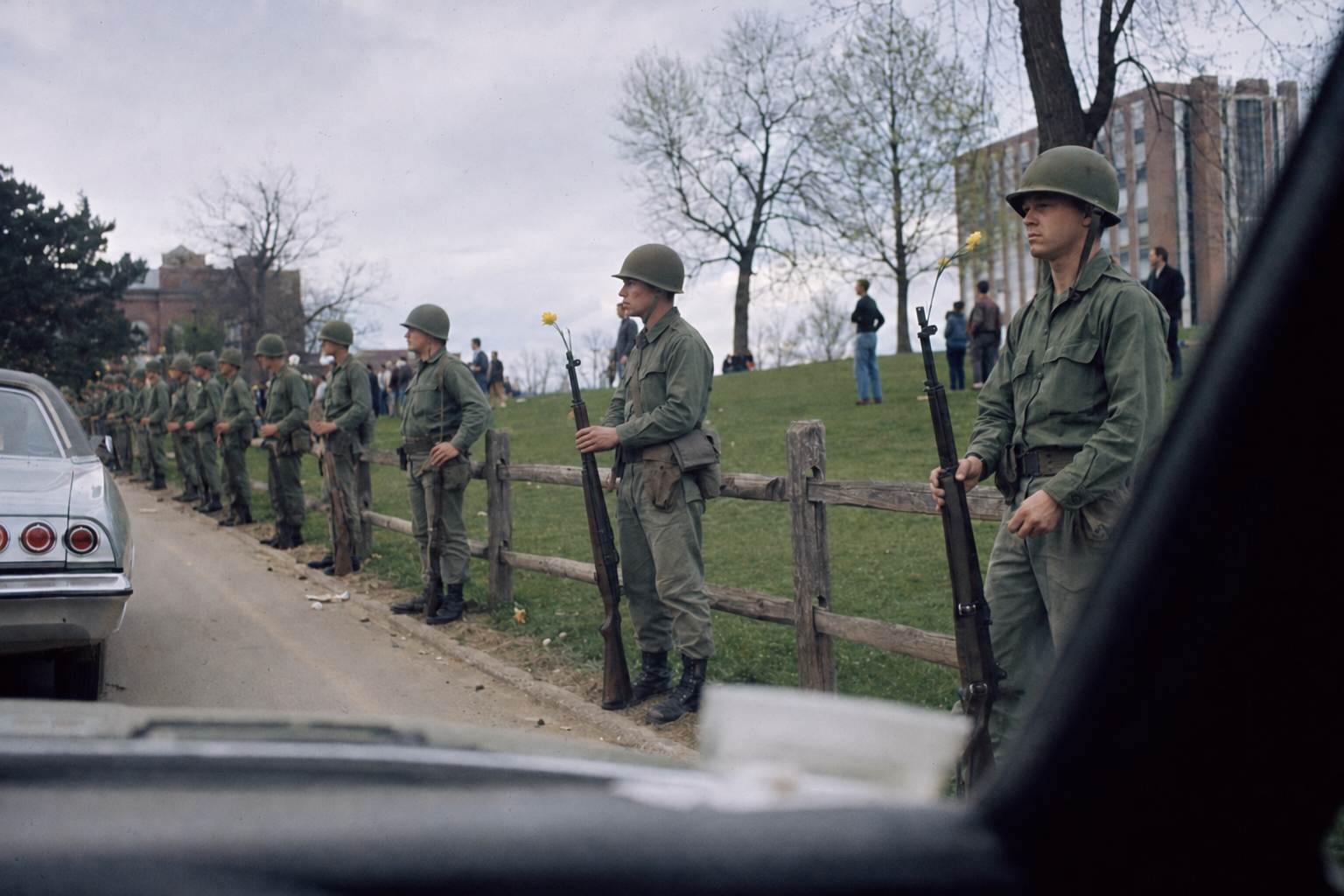
On May 3, 1970, Carol and I were at my grandparents' fiftieth wedding anniversary, just across the street from Kent State University. I still remember driving in and feeling a chill I could not name. Soldiers stood scattered across the campus grounds, and the air carried a tension that did not belong in a place where I had once run through the fields as a boy. It felt as though the familiar had slipped out the back door, and something grim had taken its place.
The next day, four students were killed.
The song that came later, "Four Dead in Ohio," would always bring me back to that weekend. Not because of the melody, but because it sealed the memory in a way nothing else could. It gave those hours a permanent name. That moment marked me. It stripped away the last of my childhood illusions and pressed me toward the decision I knew was coming. A month later I would turn eighteen and face the draft, carrying the weight of that weekend into whatever came next.
It was in that same unsettled season that I came across a book written by a young protestor serving time for the stand he refused to renounce. His letters were plain, almost spare, yet every one of them ended the same way: Agape et Shalom. Love and peace. Two small words, but they carried a weight far beyond the pages that held them.
I did not realize it then, but those words became the quiet center around which my life would eventually turn. They followed me like a ghost, held me like a chain to something true, comforted me like a blanket when the world felt too sharp, and more than once became a lifeline.
They slipped into my conscience, into my anger, into my hope, and ultimately into the conscientious objector application I would write. Not as decoration. Not as sentiment. As a declaration of what I was trying, clumsily, to live toward.
Life carried me on. I enrolled in college, learned to sail from a friend, and with my father's quiet approval, he had been a Seabee in the war, after all, I scraped together enough money to buy a twenty-seven-foot sloop. She was rugged, weathered, and mine. I christened her Agape, home port Earth, because by then love felt like the truest compass I had.
That boat carried me from Ohio to Florida, threading through the New York Barge Canal and down the Atlantic coast. Somewhere along that journey, word reached me: my draft lottery number had come up, 304. Safe. Free. The fear and tension that had shadowed me for years evaporated in a single stroke of luck, or so I thought. I was spared. My friend, whose number was ten, was not.
At that point I still had no real idea what agape meant beyond its simplest translation: love. I thought it was merely one of many words for the same thing, nothing particularly distinct. But by naming my boat Agape and raising it as my banner, I had stepped onto a path far larger than I understood. That voyage was not only across the water. It was the beginning of a lifelong journey of discovering that agape, selfless love, is more than a word. It is the compass, the trail, and the destination.
This site, in many ways, grows out of that trail.
Agape et Shalom is not just a title to me. It is the echo of a question that followed me out of youth and into age: What does it mean to live in truth, to love rightly, and to walk toward peace in a world so often torn by pride, violence, fear, and confusion? I did not begin with answers. I began with unrest, with conscience, with history pressing in, and with two words I barely understood.
Over time, those words became more than a phrase. They became a measure. They challenged my anger, my pride, my ambitions, and my illusions. They returned in moments of hardship, work, marriage, failure, and grace. They helped me see, however imperfectly, that Christ's call is not toward comfort or self-justification, but toward surrender—to deny oneself, pick up one's cross, and follow Him.
That is why this site exists.
Not because I have mastered agape, but because I have spent a lifetime being taught by it. Not because the world has become simpler, but because it has become clearer that without selfless love, truth becomes a weapon, peace becomes an illusion, and even good intentions become distorted by pride.
My hope is simple: that as you read these pages, you may discover for yourself that agape is not an ornament for religious language, nor merely a noble ideal. It is the one thing strong enough to carry us through the good, the bad, and the ugly, and to lead us at last toward peace, toward shalom.
followup story First Night Aboard Agape
followup story First Night Aboard Agape